Ch. 15 - Structural Identification 2: Nuclear Magnetic Resonance Spectroscopy
Mullins - Organic Chemistry: A Learner Centered Approach 1st Edition
Mullins1st EditionOrganic Chemistry: A Learner Centered ApproachISBN: 9780137566471Non è quello che usi tu?Cambia libro di testo
Capitolo 14, Problema 20

Without worrying about the relative location of the signals (i.e., the chemical shift) or the splitting patterns, draw a spectrum of the following molecule, being sure to indicate the integration of each peak. Label each signal based on the set of equivalent hydrogens to which it corresponds. [We expand on this question in future assessments.]
Chemical structure with labeled hydrogen groups: a, b, c, d, e, showing connectivity and equivalence for NMR analysis.

Guida verificata passo dopo passo
1
Identify all the unique sets of equivalent hydrogens in the molecule. Equivalent hydrogens are those that are in the same chemical environment and will produce the same NMR signal.
Determine the number of hydrogens in each set of equivalent hydrogens. This will help in assigning the integration of each peak in the NMR spectrum.
For each set of equivalent hydrogens, assign a signal in the NMR spectrum. The integration of each signal should correspond to the number of hydrogens in that set.
Label each signal in the spectrum with the corresponding set of equivalent hydrogens. This helps in identifying which part of the molecule each signal represents.
Ensure that the total integration of all signals matches the total number of hydrogens in the molecule, confirming that all hydrogens have been accounted for in the spectrum.

Risposta video verificata per un problema simile:

Questa soluzione video è stata consigliata dai nostri tutor come utile per risolvere questo problema.

Concetti chiave

Ecco i concetti essenziali che devi comprendere per rispondere correttamente alla domanda.

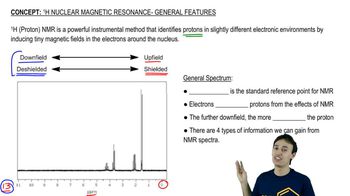
NMR Spectroscopy

Nuclear Magnetic Resonance (NMR) Spectroscopy is a technique used to determine the structure of organic compounds by observing the magnetic properties of certain atomic nuclei. In NMR, the environment of hydrogen atoms (protons) in a molecule is analyzed, providing information about the number of chemically equivalent hydrogens and their connectivity within the molecule.
Video consigliato:
10:06
General NMR Features

Chemical Equivalence

Chemical equivalence refers to the condition where hydrogen atoms in a molecule are in identical environments, leading them to produce the same NMR signal. Equivalent hydrogens are indistinguishable by NMR and contribute to the same peak in the spectrum. Identifying sets of equivalent hydrogens is crucial for interpreting NMR spectra and understanding molecular structure.
Video consigliato:
Percorso guidato
3:11
Chemical Reactions of Phosphate Anhydrides Concept 1

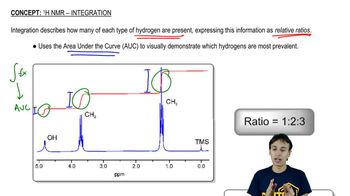
Integration of NMR Peaks

Integration in NMR spectroscopy refers to the measurement of the area under each peak in the spectrum, which is proportional to the number of hydrogens contributing to that signal. This allows chemists to determine the relative number of equivalent hydrogens in different environments within the molecule, aiding in the structural elucidation of the compound.
Video consigliato:
06:46
1H NMR Integration