Ch. 16 - Metals in Organic Chemistry
Mullins - Organic Chemistry: A Learner Centered Approach 1st Edition
Mullins1st EditionOrganic Chemistry: A Learner Centered ApproachISBN: 9780137566471Non è quello che usi tu?Cambia libro di testo
Capitolo 15, Problema 34

Based on the stereochemical result alone, how can you tell that this reaction does not proceed by an Sₙ2 mechanism?
Grignard reaction showing alkyl chloride and lithium cuprate forming a new carbon-carbon bond with stereochemistry.

Guida verificata passo dopo passo
1
Understand the characteristics of an Sₙ2 mechanism: It involves a single concerted step where the nucleophile attacks the electrophile from the opposite side of the leaving group, leading to inversion of configuration at the stereocenter.
Identify the stereochemical outcome of the reaction: If the reaction results in retention of configuration or a racemic mixture, it suggests that the mechanism is not Sₙ2, as Sₙ2 reactions exclusively lead to inversion of configuration.
Consider the stereochemistry of the starting material and the product: Compare the stereochemistry of the reactant and product. If the stereochemistry is retained or if both enantiomers are formed, it indicates that the reaction does not proceed via an Sₙ2 mechanism.
Evaluate the reaction conditions: Sₙ2 reactions typically occur in polar aprotic solvents and favor primary substrates. If the reaction conditions or substrate do not align with these characteristics, it further suggests a different mechanism.
Explore alternative mechanisms: If the stereochemical result does not align with an Sₙ2 mechanism, consider other possibilities such as Sₙ1, which involves a carbocation intermediate and can lead to racemization, or other mechanisms that might explain the observed stereochemistry.

Risposta video verificata per un problema simile:

Questa soluzione video è stata consigliata dai nostri tutor come utile per risolvere questo problema.

Concetti chiave

Ecco i concetti essenziali che devi comprendere per rispondere correttamente alla domanda.

Sₙ2 Mechanism

The Sₙ2 mechanism is a bimolecular nucleophilic substitution reaction characterized by a single concerted step where the nucleophile attacks the substrate from the opposite side of the leaving group, leading to an inversion of stereochemistry. This inversion is known as the 'Walden inversion' and is a key indicator of an Sₙ2 reaction.
Video consigliato:
04:32
General Mechanism

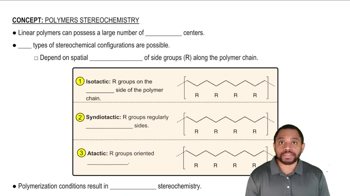
Stereochemistry

Stereochemistry involves the study of the spatial arrangement of atoms in molecules and its impact on chemical reactions. In the context of nucleophilic substitution reactions, stereochemistry is crucial for determining the mechanism, as Sₙ2 reactions result in inversion of configuration, while other mechanisms may lead to retention or racemization.
Video consigliato:
Percorso guidato
1:38
Polymer Stereochemistry Concept 1

Sₙ1 Mechanism

The Sₙ1 mechanism is a unimolecular nucleophilic substitution reaction that proceeds through a two-step process involving the formation of a carbocation intermediate. This mechanism often leads to racemization, as the planar carbocation allows the nucleophile to attack from either side, resulting in a mixture of stereochemical outcomes.
Video consigliato:
04:32
General Mechanism