Ch. 17 - Carbonyl Addition Reactions: Aldehydes and Ketones
Mullins - Organic Chemistry: A Learner Centered Approach 1st Edition
Mullins1st EditionOrganic Chemistry: A Learner Centered ApproachISBN: 9780137566471Non è quello che usi tu?Cambia libro di testo
Capitolo 16, Problema 54

During an oxidation reaction, there must also be a reduction. What is reduced in the Pinnick oxidation?

Guida verificata passo dopo passo
1
Understand the Pinnick oxidation: It is a chemical reaction used to oxidize aldehydes to carboxylic acids using sodium chlorite (NaClO2) as the oxidizing agent.
Identify the role of sodium chlorite (NaClO2): In the Pinnick oxidation, sodium chlorite acts as the oxidizing agent, meaning it will be reduced during the reaction.
Recognize the concept of redox reactions: In any redox reaction, oxidation and reduction occur simultaneously. The substance that is oxidized loses electrons, while the substance that is reduced gains electrons.
Determine what is reduced: In the Pinnick oxidation, sodium chlorite (NaClO2) is reduced to chloride ions (Cl-) as it oxidizes the aldehyde to a carboxylic acid.
Summarize the redox process: The aldehyde is oxidized to a carboxylic acid, and sodium chlorite is reduced to chloride ions, completing the redox cycle in the Pinnick oxidation.

Risposta video verificata per un problema simile:

Questa soluzione video è stata consigliata dai nostri tutor come utile per risolvere questo problema.
Durata del video:
2m

Concetti chiave

Ecco i concetti essenziali che devi comprendere per rispondere correttamente alla domanda.

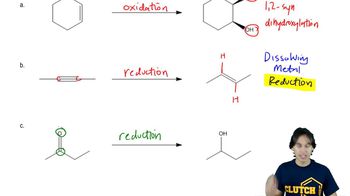
Oxidation-Reduction Reactions

Oxidation-reduction (redox) reactions involve the transfer of electrons between two species. Oxidation refers to the loss of electrons, while reduction refers to the gain of electrons. In any redox reaction, one species is oxidized and another is reduced, maintaining the balance of electron transfer.
Video consigliato:
00:54
Distinguishing between Oxidation and Reduction

Pinnick Oxidation

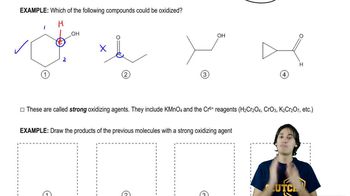
Pinnick oxidation is a chemical reaction used to convert aldehydes into carboxylic acids using sodium chlorite (NaClO2) as the oxidizing agent. This reaction is often performed in the presence of a buffer to maintain a neutral pH, which helps in the selective oxidation of aldehydes without affecting other functional groups.
Video consigliato:
03:40
Strong oxidizing agents

Role of Sodium Chlorite

In the Pinnick oxidation, sodium chlorite (NaClO2) acts as the oxidizing agent. During the reaction, sodium chlorite is reduced to chloride ions (Cl-) while oxidizing the aldehyde to a carboxylic acid. This reduction of sodium chlorite is essential for the overall redox balance of the reaction.
Video consigliato:
03:19
Sodium Alkynide Alkylation