Ch. 19 - Nucleophilic Acyl Substitution 2: Carboxylic Acid Derivatives
Mullins - Organic Chemistry: A Learner Centered Approach 1st Edition
Mullins1st EditionOrganic Chemistry: A Learner Centered ApproachISBN: 9780137566471Non è quello che usi tu?Cambia libro di testo
Capitolo 18, Problema 54

Beginning with an amide, two different pathways produce the same compound. Predict the product of these two pathways.
Chemical reaction pathways from amide to same product using P2O5, Li, H2SO4, H2O, SOCl2, and LiCu reagents.

Guida verificata passo dopo passo
1
Step 1: Understand the structure of an amide. An amide is a functional group characterized by a carbonyl group (C=O) linked to a nitrogen atom (N). The general formula is R-C(=O)-NR2, where R can be a hydrogen or an organic substituent.
Step 2: Identify the two pathways that can transform an amide into the same product. Common pathways include hydrolysis and reduction. Hydrolysis involves breaking the amide bond using water, while reduction involves adding hydrogen to the amide.
Step 3: For the hydrolysis pathway, consider the reaction of the amide with water in the presence of an acid or base catalyst. This typically results in the formation of a carboxylic acid and an amine. The reaction can be represented as: R1-C(=O)NR2+H2O→R1-C(=O)OH+R2NH2
Step 4: For the reduction pathway, consider the reaction of the amide with a reducing agent such as lithium aluminum hydride (LiAlH4). This typically results in the formation of an amine. The reaction can be represented as: R1-C(=O)NR2+LiAlH44→R1CH22NHR2
Step 5: Compare the products of both pathways. In this case, both pathways lead to the formation of an amine, which is the common product. The hydrolysis pathway produces an amine along with a carboxylic acid, while the reduction pathway directly produces an amine.

Risposta video verificata per un problema simile:

Questa soluzione video è stata consigliata dai nostri tutor come utile per risolvere questo problema.

Concetti chiave

Ecco i concetti essenziali che devi comprendere per rispondere correttamente alla domanda.

Amide Structure and Reactivity

Amides are organic compounds characterized by a carbonyl group (C=O) linked to a nitrogen atom. They are generally less reactive than other carbonyl-containing compounds due to resonance stabilization. Understanding the structure and reactivity of amides is crucial for predicting their behavior in chemical reactions, including pathways that transform them into other compounds.
Video consigliato:
01:33
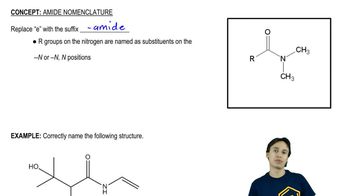
Amide Nomenclature

Hydrolysis of Amides

Amide hydrolysis is a chemical reaction where an amide is converted into a carboxylic acid and an amine or ammonia. This process typically requires acidic or basic conditions and heat. Recognizing this pathway is essential for predicting products formed from amides, as hydrolysis is a common transformation in organic chemistry.
Video consigliato:
01:33
Amide Nomenclature

Reduction of Amides

Reduction of amides involves converting the amide group into an amine, often using reducing agents like lithium aluminum hydride (LiAlH4). This pathway is significant for synthesizing amines from amides, and understanding the conditions and mechanisms of reduction helps in predicting the final product of such reactions.
Video consigliato:
01:33
Amide Nomenclature