Ch. 19 - Nucleophilic Acyl Substitution 2: Carboxylic Acid Derivatives
Mullins - Organic Chemistry: A Learner Centered Approach 1st Edition
Mullins1st EditionOrganic Chemistry: A Learner Centered ApproachISBN: 9780137566471Non è quello che usi tu?Cambia libro di testo
Capitolo 18, Problema 40b

The esters shown differ only by the alkoxy group.
(i) Predict the product(s) obtained when these react with DIBAl-H.
(ii) Based on your answer, in a sequence like this, would there ever be a need to convert from one ester to another?
(b) Chemical reaction scheme showing DIBAl-H treatment of an ester, followed by hydrolysis with water.

Guida verificata passo dopo passo
1
Identify the ester functional group in the given compound. The ester is characterized by the presence of a carbonyl group (C=O) adjacent to an alkoxy group (O-R).
Understand the role of DIBAl-H (Diisobutylaluminum hydride) in the reaction. DIBAl-H is a reducing agent that selectively reduces esters to aldehydes at low temperatures, such as -78°C.
Predict the product of the reaction. When the ester reacts with DIBAl-H, the alkoxy group is replaced by a hydrogen atom, converting the ester into an aldehyde.
Consider the need to convert from one ester to another. Since DIBAl-H reduces the ester to an aldehyde, the specific alkoxy group in the ester does not affect the final aldehyde product. Therefore, there is generally no need to convert from one ester to another in this sequence.
Conclude that the reaction with DIBAl-H is efficient for reducing esters to aldehydes without the need for altering the alkoxy group, as the alkoxy group does not influence the final product in this context.

Risposta video verificata per un problema simile:

Questa soluzione video è stata consigliata dai nostri tutor come utile per risolvere questo problema.

Concetti chiave

Ecco i concetti essenziali che devi comprendere per rispondere correttamente alla domanda.

DIBAl-H Reactivity

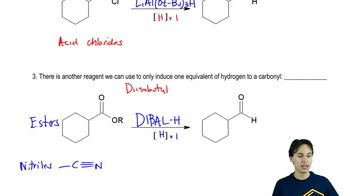
DIBAl-H (Diisobutylaluminum hydride) is a selective reducing agent commonly used in organic chemistry to reduce esters to aldehydes. Understanding its reactivity is crucial, as it allows chemists to predict the outcome of reactions involving esters. When an ester reacts with DIBAl-H, the carbonyl group is reduced, while the alkoxy group remains intact, leading to the formation of an aldehyde.
Video consigliato:
02:10
DIBAL-H on Esters and Nitriles

Alkoxy Group Influence

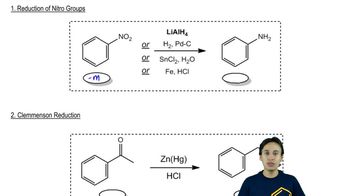
The alkoxy group in an ester can significantly influence the reactivity and properties of the compound. Different alkoxy groups can affect steric hindrance and electronic effects, which in turn can alter the reaction pathways and products formed during chemical reactions. Recognizing how these groups interact with reagents like DIBAl-H is essential for predicting reaction outcomes.
Video consigliato:
04:42
Sequence Groups

Ester Interconversion

Ester interconversion refers to the process of transforming one ester into another, often involving changes in the alkoxy group. This can be necessary for various synthetic strategies, especially when specific reactivity or selectivity is required in subsequent reactions. Understanding the conditions and mechanisms for ester interconversion is important for effective synthetic planning in organic chemistry.
Video consigliato:
02:39
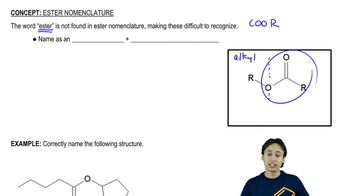
Ester Nomenclature