Ch. 2 - General Chemistry Translated: Finding the Electrons
Mullins - Organic Chemistry: A Learner Centered Approach 1st Edition
Mullins1st EditionOrganic Chemistry: A Learner Centered ApproachISBN: 9780137566471Non è quello che usi tu?Cambia libro di testo
Capitolo 1, Problema 29d

Draw the Lewis structure for the following ions. Be sure to calculate the formal charge of each atom to confirm that your structure is correct.
(d) AlCl4-

Guida verificata passo dopo passo
1
Step 1: Identify the total number of valence electrons in the AlCl⁻₄ ion. Aluminum (Al) has 3 valence electrons, each chlorine (Cl) has 7 valence electrons, and the negative charge adds 1 extra electron. Calculate the total number of valence electrons: 3 + (7 × 4) + 1.
Step 2: Place Aluminum (Al) as the central atom since it is less electronegative than chlorine. Arrange the four chlorine atoms around the aluminum atom.
Step 3: Draw single bonds between the Aluminum atom and each of the four Chlorine atoms. Each single bond represents 2 electrons, so subtract these electrons from the total valence electron count.
Step 4: Distribute the remaining electrons as lone pairs around the chlorine atoms to satisfy the octet rule for each chlorine. Ensure that all chlorine atoms have 8 electrons (including bonding electrons).
Step 5: Calculate the formal charge for each atom using the formula: Formal charge = (Valence electrons) - (Non-bonding electrons) - (Bonding electrons ÷ 2). Verify that the sum of the formal charges equals the overall charge of the ion (-1).

Risposta video verificata per un problema simile:

Questa soluzione video è stata consigliata dai nostri tutor come utile per risolvere questo problema.
Durata del video:
5m

Concetti chiave

Ecco i concetti essenziali che devi comprendere per rispondere correttamente alla domanda.

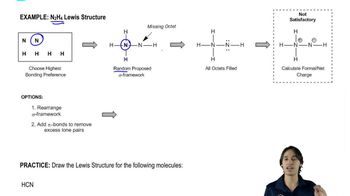
Lewis Structures

Lewis structures are diagrams that represent the bonding between atoms in a molecule and the lone pairs of electrons that may exist. They use dots to represent valence electrons and lines to represent bonds between atoms. Understanding how to draw Lewis structures is essential for visualizing molecular geometry and predicting reactivity.
Video consigliato:
04:12
Drawing the Lewis Structure for N2H4.

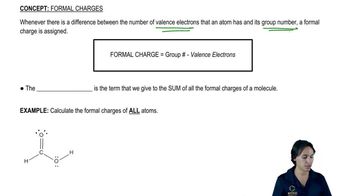
Formal Charge

Formal charge is a theoretical charge assigned to an atom in a molecule, calculated based on the number of valence electrons, the number of non-bonding electrons, and the number of bonds. It helps in assessing the stability of a Lewis structure; ideally, the formal charges should be minimized and should reflect the actual charge distribution in the molecule.
Video consigliato:
01:34
Calculating formal and net charge.

Ionic Compounds

Ionic compounds are formed when atoms transfer electrons, resulting in the formation of charged ions. In the case of AlCl₄⁻, aluminum donates electrons to chlorine atoms, creating a negatively charged ion. Understanding the nature of ionic compounds is crucial for predicting their properties and behavior in chemical reactions.
Video consigliato:
01:40
Defining meso compounds.