Ch. 2 - General Chemistry Translated: Finding the Electrons
Mullins - Organic Chemistry: A Learner Centered Approach 1st Edition
Mullins1st EditionOrganic Chemistry: A Learner Centered ApproachISBN: 9780137566471Non è quello che usi tu?Cambia libro di testo
Capitolo 1, Problema 36a

For the molecules shown, indicate the direction of the dipole moment.
(a)

Guida verificata passo dopo passo
1
Identify the polar bonds in the molecule by determining the electronegativity difference between the atoms in each bond. A bond is polar if the electronegativity difference is significant (generally greater than 0.4).
Determine the direction of each bond dipole moment. The dipole moment points from the less electronegative atom to the more electronegative atom. Use the periodic table to compare electronegativities.
Consider the molecular geometry to assess how the individual bond dipoles combine. If the molecule is symmetrical, the dipole moments may cancel out, resulting in no net dipole moment. If the molecule is asymmetrical, the dipole moments may add up to create a net dipole moment.
Draw the molecule's structure and use arrows to represent the direction of each bond dipole moment. The arrow should point toward the more electronegative atom, with a small cross at the tail to indicate the positive end.
Combine the bond dipoles vectorially to determine the overall direction of the molecular dipole moment. If the molecule has a net dipole moment, indicate its direction with a larger arrow pointing from the positive to the negative end of the molecule.

Risposta video verificata per un problema simile:

Questa soluzione video è stata consigliata dai nostri tutor come utile per risolvere questo problema.
Durata del video:
4m

Concetti chiave

Ecco i concetti essenziali che devi comprendere per rispondere correttamente alla domanda.

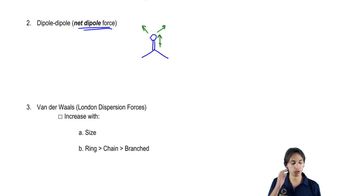
Dipole Moment

The dipole moment is a vector quantity that represents the separation of positive and negative charges in a molecule. It is calculated as the product of the charge and the distance between the charges. A molecule with a dipole moment has a positive end and a negative end, indicating the direction in which the electron density is unevenly distributed.
Video consigliato:
01:46
How dipole-dipole forces work.

Electronegativity

Electronegativity is a measure of an atom's ability to attract and hold onto electrons within a chemical bond. Atoms with higher electronegativity will pull electron density towards themselves, creating partial negative charges, while less electronegative atoms will have partial positive charges. Understanding electronegativity is crucial for predicting the direction of the dipole moment in a molecule.
Video consigliato:
1:47
Electronegativity

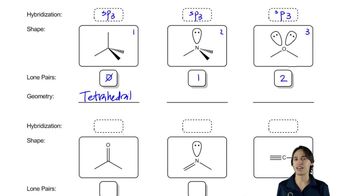
Molecular Geometry

Molecular geometry refers to the three-dimensional arrangement of atoms in a molecule. The shape of a molecule influences how dipole moments add up; in symmetrical molecules, dipole moments may cancel out, resulting in a nonpolar molecule, while in asymmetrical molecules, they can reinforce each other, leading to a polar molecule. Analyzing molecular geometry is essential for determining the overall dipole moment direction.
Video consigliato:
07:44
Molecular Geometry Explained.