Ch. 2 - General Chemistry Translated: Finding the Electrons
Mullins - Organic Chemistry: A Learner Centered Approach 1st Edition
Mullins1st EditionOrganic Chemistry: A Learner Centered ApproachISBN: 9780137566471Non è quello che usi tu?Cambia libro di testo
Capitolo 1, Problema 37

Hydrogen forms bonds without hybridizing. Why?

Guida verificata passo dopo passo
1
Hydrogen has only one electron and one orbital, the 1s orbital, which is spherical in shape. This means it does not have additional orbitals to hybridize.
Hybridization occurs when atomic orbitals mix to form new hybrid orbitals, typically in atoms with multiple orbitals (like carbon, nitrogen, or oxygen). Hydrogen lacks the necessary orbitals for this process.
The single 1s orbital of hydrogen is sufficient to overlap with other orbitals (like the sp³ orbitals of carbon in methane) to form stable covalent bonds.
Since hydrogen does not have p, d, or f orbitals, it cannot undergo hybridization. Its bonding behavior is entirely based on the direct use of its 1s orbital.
This simplicity in bonding makes hydrogen unique and allows it to form single covalent bonds without the need for hybridization.

Risposta video verificata per un problema simile:

Questa soluzione video è stata consigliata dai nostri tutor come utile per risolvere questo problema.
Durata del video:
1m

Concetti chiave

Ecco i concetti essenziali che devi comprendere per rispondere correttamente alla domanda.

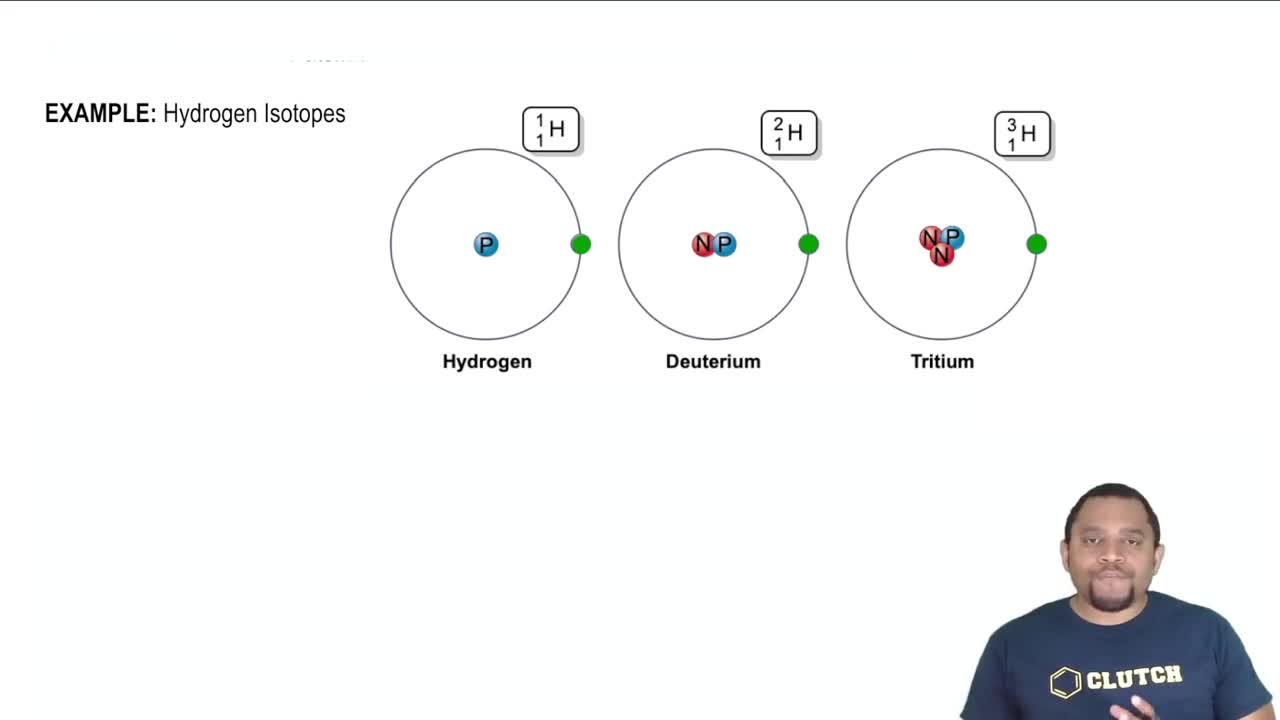
Atomic Structure of Hydrogen

Hydrogen has a simple atomic structure, consisting of one proton and one electron. This simplicity allows hydrogen to form bonds using its single electron without the need for hybridization, which is a process that involves mixing atomic orbitals to create new hybrid orbitals for bonding.
Video consigliato:
03:06
Understanding the hydrogen isotopes.

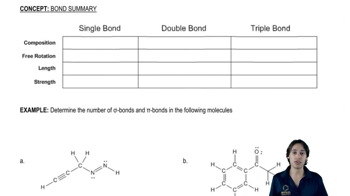
Bonding in Chemistry

In chemistry, bonding refers to the interactions that hold atoms together in molecules. Hydrogen typically forms covalent bonds by sharing its single electron with other atoms, allowing it to achieve a stable electron configuration similar to that of helium, without the necessity of hybrid orbitals.
Video consigliato:
06:00
Single bonds, double bonds, and triple bonds.

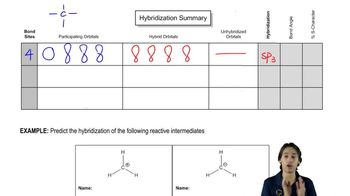
Hybridization

Hybridization is a concept in organic chemistry where atomic orbitals mix to form new hybrid orbitals that can accommodate bonding. However, in the case of hydrogen, its single s orbital is sufficient for bonding, making hybridization unnecessary for its interactions with other elements.
Video consigliato:
10:43
Using bond sites to predict hybridization