Ch. 2 - General Chemistry Translated: Finding the Electrons
Mullins - Organic Chemistry: A Learner Centered Approach 1st Edition
Mullins1st EditionOrganic Chemistry: A Learner Centered ApproachISBN: 9780137566471Non è quello che usi tu?Cambia libro di testo
Capitolo 1, Problema 4c

How many valence shell electrons do each of the following elements contain? How many new bonds can each form?
(c) O

Guida verificata passo dopo passo
1
Step 1: Determine the group number of oxygen in the periodic table. Oxygen is in Group 16 (or Group VI A in older notations). Elements in this group have 6 valence electrons.
Step 2: Recall that the number of valence electrons corresponds to the electrons in the outermost shell of an atom. For oxygen, this is 6 valence electrons.
Step 3: To determine how many new bonds oxygen can form, consider the octet rule. Atoms tend to form bonds to achieve a full outer shell of 8 electrons.
Step 4: Subtract the number of valence electrons from 8 to find the number of electrons oxygen needs to complete its octet. For oxygen, 8 - 6 = 2 electrons are needed.
Step 5: Conclude that oxygen can form 2 new bonds, as it needs 2 more electrons to complete its octet. These bonds can be single or part of a double bond, depending on the molecule.

Risposta video verificata per un problema simile:

Questa soluzione video è stata consigliata dai nostri tutor come utile per risolvere questo problema.
Durata del video:
2m

Concetti chiave

Ecco i concetti essenziali che devi comprendere per rispondere correttamente alla domanda.

Valence Electrons

Valence electrons are the outermost electrons of an atom and are crucial for determining how an element interacts and bonds with others. For oxygen (O), which is in group 16 of the periodic table, there are six valence electrons. These electrons are involved in chemical bonding, influencing the element's reactivity and the types of bonds it can form.
Video consigliato:
03:40
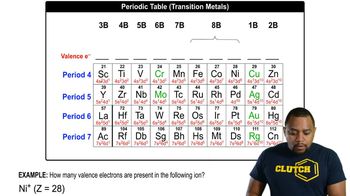
Valence Electrons of Transition Metals

Covalent Bonds

Covalent bonds are formed when two atoms share pairs of electrons, allowing them to achieve a full outer shell and greater stability. Oxygen typically forms two covalent bonds by sharing its six valence electrons with other atoms, such as hydrogen in water (H2O). This ability to form bonds is essential for understanding molecular structures and reactivity.
Video consigliato:
11:33
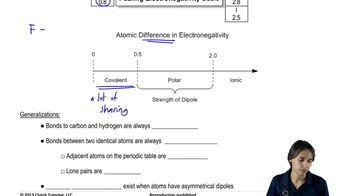
Differences between ionic, polar and covalent bonds

Octet Rule

The octet rule states that atoms tend to form bonds in such a way that they have eight electrons in their valence shell, achieving a stable electron configuration similar to noble gases. For oxygen, which has six valence electrons, forming two bonds allows it to complete its octet, making it more stable. This principle is fundamental in predicting how elements will bond and interact in chemical reactions.
Video consigliato:
02:59
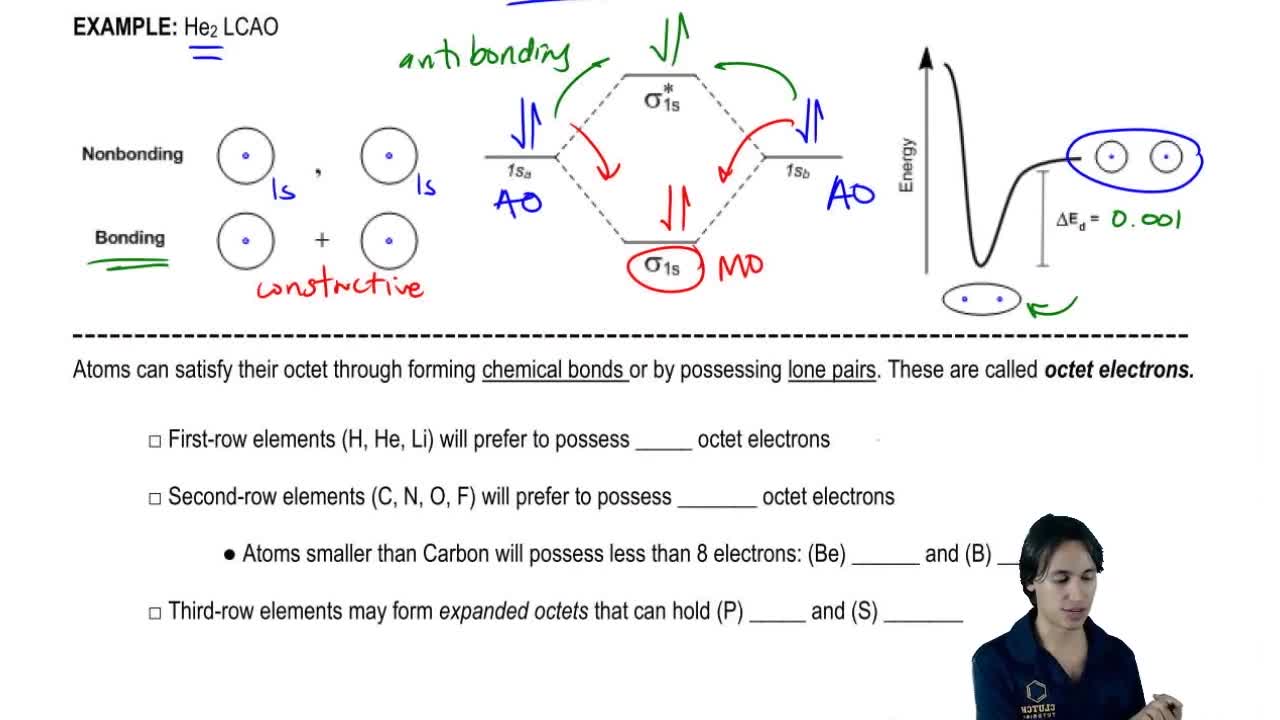
The octet rule.