Ch. 20 - Enolates: Carbonyl Addition and Substitution
Mullins - Organic Chemistry: A Learner Centered Approach 1st Edition
Mullins1st EditionOrganic Chemistry: A Learner Centered ApproachISBN: 9780137566471Non è quello che usi tu?Cambia libro di testo
Capitolo 19, Problema 18a

Specify which in each pair is the harder Lewis acid. Justify your choice beyond just looking at Table 20.2.
(a) Al3+ vs. B3+

Guida verificata passo dopo passo
1
Step 1: Recall the definition of a Lewis acid. A Lewis acid is a species that can accept a pair of electrons. The strength of a Lewis acid depends on factors such as charge density, electronegativity, and the size of the ion.
Step 2: Compare the charges of Al³⁺ and B³⁺. Both ions have a +3 charge, which means they have the same formal charge. However, the size of the ion and its charge density will play a significant role in determining which is the harder Lewis acid.
Step 3: Consider the size of the ions. Aluminum (Al) is in Period 3 of the periodic table, while boron (B) is in Period 2. This means that Al³⁺ is larger in size compared to B³⁺. A smaller ion like B³⁺ will have a higher charge density because the +3 charge is concentrated over a smaller volume.
Step 4: Analyze the charge density. Since B³⁺ has a smaller ionic radius and a higher charge density compared to Al³⁺, it will have a stronger ability to attract electron pairs, making it a harder Lewis acid.
Step 5: Conclude that B³⁺ is the harder Lewis acid due to its smaller size and higher charge density, which increases its ability to accept electron pairs. This conclusion is based on fundamental principles of charge density and periodic trends, not just referencing a table.

Risposta video verificata per un problema simile:

Questa soluzione video è stata consigliata dai nostri tutor come utile per risolvere questo problema.
Durata del video:
3m

Concetti chiave

Ecco i concetti essenziali che devi comprendere per rispondere correttamente alla domanda.

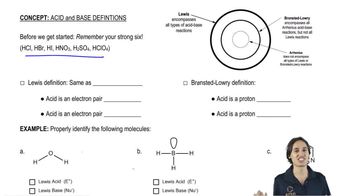
Lewis Acids and Bases

Lewis acids are defined as electron pair acceptors, while Lewis bases are electron pair donors. This concept is fundamental in understanding acid-base reactions in organic chemistry, as it expands the traditional Brønsted-Lowry definitions. The strength of a Lewis acid is influenced by its ability to stabilize the resulting complex after accepting an electron pair.
Video consigliato:
02:49
The Lewis definition of acids and bases.

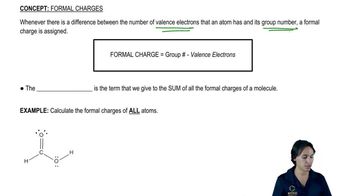
Charge Density

Charge density refers to the distribution of electric charge over a given volume. In the context of Lewis acids, a higher charge density typically indicates a stronger acid, as it can attract electron pairs more effectively. For cations like Al³⁺ and B³⁺, the charge density is influenced by their ionic radii and the magnitude of their positive charge.
Video consigliato:
01:34
Calculating formal and net charge.

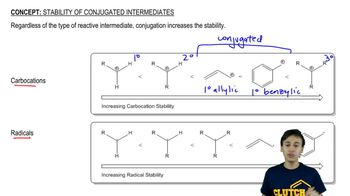
Stability of the Conjugate Base

The stability of the conjugate base formed after a Lewis acid accepts an electron pair is crucial in determining the strength of the acid. A more stable conjugate base will favor the forward reaction, making the original species a stronger Lewis acid. Factors such as electronegativity and resonance can significantly affect the stability of the conjugate base.
Video consigliato:
04:31
Stability of Conjugated Intermediates