Ch. 20 - Enolates: Carbonyl Addition and Substitution
Mullins - Organic Chemistry: A Learner Centered Approach 1st Edition
Mullins1st EditionOrganic Chemistry: A Learner Centered ApproachISBN: 9780137566471Non è quello che usi tu?Cambia libro di testo
Capitolo 19, Problema 17c

Specify which in each pair is the harder Lewis base. Justify your choice beyond just looking at Table 20.2.
(c) I- vs. F-

Guida verificata passo dopo passo
1
Step 1: Recall the concept of Lewis bases. A Lewis base is a species that donates an electron pair to a Lewis acid. The 'hardness' or 'softness' of a Lewis base is determined by its polarizability and charge density.
Step 2: Analyze the chemical properties of I⁻ and F⁻. I⁻ is a larger ion with lower charge density and higher polarizability, making it a softer base. F⁻ is a smaller ion with higher charge density and lower polarizability, making it a harder base.
Step 3: Refer to the table provided. F⁻ is explicitly listed under 'Hard bases,' while I⁻ is listed under 'Soft bases.' This classification aligns with their polarizability and charge density.
Step 4: Justify the choice beyond the table. Hard bases like F⁻ tend to interact strongly with hard acids due to their high charge density and low polarizability. Soft bases like I⁻ interact more effectively with soft acids due to their high polarizability and ability to form covalent bonds.
Step 5: Conclude that F⁻ is the harder Lewis base compared to I⁻, based on its smaller size, higher charge density, and lower polarizability.

Risposta video verificata per un problema simile:

Questa soluzione video è stata consigliata dai nostri tutor come utile per risolvere questo problema.

Concetti chiave

Ecco i concetti essenziali che devi comprendere per rispondere correttamente alla domanda.

Lewis Acids and Bases

Lewis acids are electron pair acceptors, while Lewis bases are electron pair donors. This concept is fundamental in understanding acid-base reactions in organic chemistry, as it allows for the classification of substances based on their ability to donate or accept electrons. The strength of a Lewis base is influenced by its ability to stabilize the negative charge and its overall electronegativity.
Video consigliato:
02:49
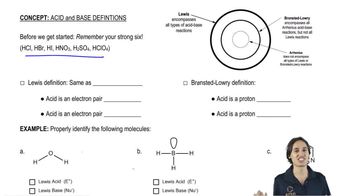
The Lewis definition of acids and bases.

Hard and Soft Acids and Bases (HSAB) Theory

The HSAB theory categorizes acids and bases as hard or soft based on their charge density and polarizability. Hard bases, like F-, are typically small, highly charged, and less polarizable, while soft bases, like I-, are larger, less charged, and more polarizable. This classification helps predict the stability of acid-base interactions and the relative strength of different Lewis bases.
Video consigliato:
02:49
The Lewis definition of acids and bases.

Comparative Strength of Lewis Bases

When comparing Lewis bases, their strength can be assessed by their ability to donate electron pairs. Factors such as electronegativity, atomic size, and charge distribution play crucial roles. In the case of I- versus F-, I- is a softer base and more polarizable, making it a stronger Lewis base compared to the harder, less polarizable F-.
Video consigliato:
02:49
The Lewis definition of acids and bases.