Ch. 21 - Conjugated Systems 1: Stability and Addition Reactions
Mullins - Organic Chemistry: A Learner Centered Approach 1st Edition
Mullins1st EditionOrganic Chemistry: A Learner Centered ApproachISBN: 9780137566471Non è quello che usi tu?Cambia libro di testo
Capitolo 20, Problema 1

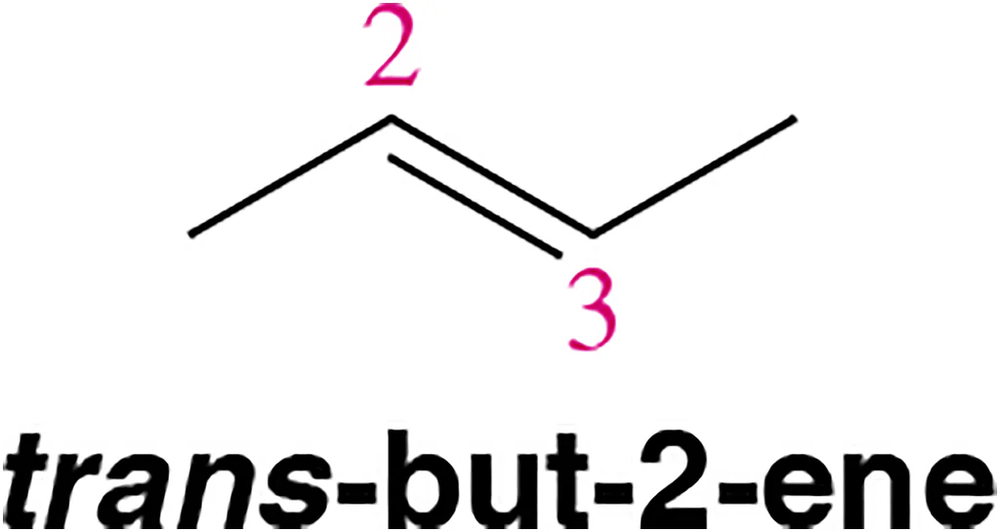
Draw the molecular orbital picture of trans-but-2-ene. Be sure to label all σ and π bonds. Is there free rotation around the C₂― C₃ bond? Why or why not?
Molecular structure of trans-but-2-ene, labeled with carbon atoms 2 and 3, showing bond types.

Guida verificata passo dopo passo
1
Start by drawing the Lewis structure of trans-but-2-ene. This molecule has a double bond between the second and third carbon atoms (C₂ and C₃), with the two methyl groups (CH₃) on opposite sides of the double bond, ensuring the 'trans' configuration.
Identify the bonding framework: The single bonds (σ bonds) are formed by the overlap of sp² hybrid orbitals from the carbon atoms with either hydrogen atoms or other carbon atoms. The double bond consists of one σ bond and one π bond. The π bond arises from the side-by-side overlap of unhybridized p orbitals on C₂ and C₃.
Draw the molecular orbital diagram: Represent the σ bonds as overlapping orbitals along the internuclear axis. For the π bond, show the unhybridized p orbitals on C₂ and C₃ overlapping above and below the plane of the molecule. Label all σ and π bonds clearly in your diagram.
Explain the lack of free rotation: The π bond in the C₂―C₃ double bond restricts rotation because breaking the π bond would require significant energy. The side-by-side overlap of the p orbitals must be maintained for the π bond to exist, which is not possible during rotation.
Conclude by emphasizing that the rigidity of the double bond is a key feature of alkenes, and it is this rigidity that gives rise to the distinct 'cis' and 'trans' isomerism observed in compounds like but-2-ene.

Risposta video verificata per un problema simile:

Questa soluzione video è stata consigliata dai nostri tutor come utile per risolvere questo problema.
Durata del video:
6m

Concetti chiave

Ecco i concetti essenziali che devi comprendere per rispondere correttamente alla domanda.

Molecular Orbitals

Molecular orbitals are formed by the combination of atomic orbitals when atoms bond together. In the case of trans-but-2-ene, the molecular orbital diagram will illustrate the distribution of electrons in σ (sigma) and π (pi) bonds. Sigma bonds result from head-on overlap of orbitals, while pi bonds arise from the side-to-side overlap of p orbitals, which is crucial for understanding the bonding in alkenes.
Video consigliato:
08:41
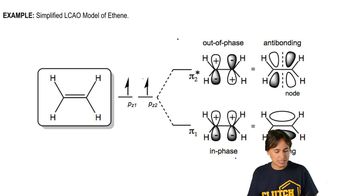
Review of Molecular Orbitals

Cis-Trans Isomerism

Cis-trans isomerism, also known as geometric isomerism, occurs in alkenes due to restricted rotation around the double bond. In trans-but-2-ene, the two methyl groups are on opposite sides of the double bond, which affects the molecule's physical properties and reactivity. Understanding this concept is essential for analyzing the structure and behavior of alkenes.
Video consigliato:
00:44
Is the following cyclohexane cis or trans?

Restricted Rotation

Restricted rotation refers to the inability of certain bonds, particularly double bonds, to rotate freely due to the presence of π bonds. In trans-but-2-ene, the C₂―C₃ double bond restricts rotation, leading to distinct geometric isomers. This restriction is a key factor in determining the stability and reactivity of alkenes, as it influences their spatial arrangement and interactions with other molecules.
Video consigliato:
05:43
Specific rotation vs. observed rotation.