Ch. 21 - Conjugated Systems 1: Stability and Addition Reactions
Mullins - Organic Chemistry: A Learner Centered Approach 1st Edition
Mullins1st EditionOrganic Chemistry: A Learner Centered ApproachISBN: 9780137566471Non è quello che usi tu?Cambia libro di testo
Capitolo 20, Problema 3

Rank the following carbocations in order of stability (1 = most stable; 5 = least stable ). Explain your order.
Five carbocation structures are shown, each with a positive charge, for ranking stability.

Guida verificata passo dopo passo
1
Step 1: Analyze the structure of each carbocation and identify the type of carbocation (primary, secondary, tertiary, allylic, or benzylic). Carbocation stability is influenced by the number of alkyl groups attached to the positively charged carbon and resonance stabilization.
Step 2: Recognize that tertiary carbocations are more stable than secondary and primary carbocations due to hyperconjugation and inductive effects. Allylic and benzylic carbocations are stabilized by resonance, which can make them even more stable than tertiary carbocations.
Step 3: Examine the first structure. It is a primary carbocation, which is the least stable type because it lacks resonance stabilization and has minimal hyperconjugation.
Step 4: Examine the second structure. It is a tertiary carbocation, which is highly stable due to the presence of three alkyl groups providing hyperconjugation and inductive effects.
Step 5: Examine the third, fourth, and fifth structures. These are allylic carbocations. The third structure has resonance stabilization with one double bond, the fourth structure has resonance stabilization with one double bond and is tertiary, and the fifth structure has resonance stabilization with two double bonds and is tertiary. Rank them based on the extent of resonance and hyperconjugation effects.

Risposta video verificata per un problema simile:

Questa soluzione video è stata consigliata dai nostri tutor come utile per risolvere questo problema.

Concetti chiave

Ecco i concetti essenziali che devi comprendere per rispondere correttamente alla domanda.

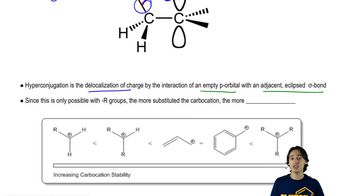
Carbocation Stability

Carbocation stability is influenced by the degree of alkyl substitution. Tertiary carbocations (three alkyl groups attached) are the most stable due to hyperconjugation and inductive effects, followed by secondary (two alkyl groups), primary (one alkyl group), and finally, methyl carbocations (no alkyl groups). The more alkyl groups surrounding the positively charged carbon, the more stable the carbocation.
Video consigliato:
05:58
Determining Carbocation Stability

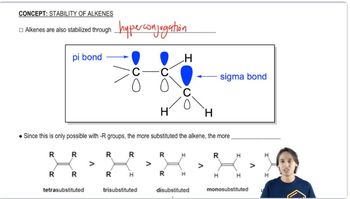
Hyperconjugation

Hyperconjugation is a stabilizing interaction that occurs when the electrons in a sigma bond (usually C-H or C-C) interact with an adjacent empty p-orbital of a carbocation. This delocalization of electrons helps to distribute the positive charge over a larger area, thereby increasing the stability of the carbocation. The more hyperconjugative interactions available, the more stable the carbocation.
Video consigliato:
04:28
Understanding trends of alkene stability.

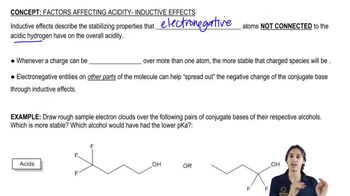
Inductive Effect

The inductive effect refers to the electron-withdrawing or electron-donating effects of substituents through sigma bonds. Alkyl groups are electron-donating, which helps to stabilize the positive charge of a carbocation. The presence of electronegative atoms or groups can destabilize a carbocation by pulling electron density away, making the understanding of inductive effects crucial for ranking carbocation stability.
Video consigliato:
01:47
Understanding the Inductive Effect.