Ch. 21 - Conjugated Systems 1: Stability and Addition Reactions
Mullins - Organic Chemistry: A Learner Centered Approach 1st Edition
Mullins1st EditionOrganic Chemistry: A Learner Centered ApproachISBN: 9780137566471Non è quello che usi tu?Cambia libro di testo
Capitolo 20, Problema 50

On a per alkene basis, which would have the more negative heat of hydrogenation?
Two alkene structures compared side by side, highlighting differences in double bond positions.

Guida verificata passo dopo passo
1
Understand the concept of heat of hydrogenation: It is the heat released when an alkene is converted to an alkane by the addition of hydrogen. A more negative heat of hydrogenation indicates a less stable alkene.
Identify the factors affecting alkene stability: More substituted alkenes (those with more alkyl groups attached to the double-bonded carbons) are generally more stable due to hyperconjugation and inductive effects.
Compare the degree of substitution: Determine the number of alkyl groups attached to the double-bonded carbons in each alkene. The alkene with fewer substituents will typically have a more negative heat of hydrogenation.
Consider the presence of any additional stabilizing or destabilizing factors: Look for conjugation with other double bonds or aromatic rings, which can stabilize the alkene, or steric hindrance, which can destabilize it.
Evaluate the alkenes based on these criteria: The alkene with the least stability (fewest substituents and least conjugation) will have the more negative heat of hydrogenation.

Risposta video verificata per un problema simile:

Questa soluzione video è stata consigliata dai nostri tutor come utile per risolvere questo problema.
Durata del video:
4m

Concetti chiave

Ecco i concetti essenziali che devi comprendere per rispondere correttamente alla domanda.

Heat of Hydrogenation

The heat of hydrogenation is the amount of energy released when an alkene undergoes hydrogenation, converting into an alkane. It is a measure of the stability of the alkene; more stable alkenes have less negative heats of hydrogenation because they release less energy upon hydrogenation. This concept helps compare the relative stabilities of different alkenes.
Video consigliato:
00:48
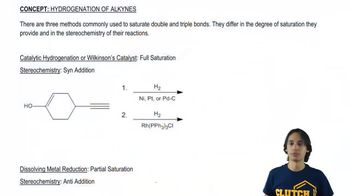
The definition of hydrogenation.

Alkene Stability

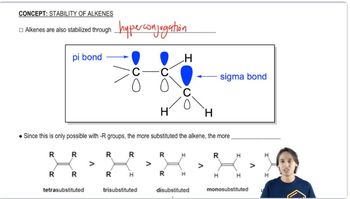
Alkene stability is influenced by factors such as the degree of substitution and the presence of electron-donating or withdrawing groups. More substituted alkenes are generally more stable due to hyperconjugation and the inductive effect, which stabilize the double bond. Understanding these factors is crucial for predicting which alkene will have a more negative heat of hydrogenation.
Video consigliato:
04:28
Understanding trends of alkene stability.

Substitution Patterns in Alkenes

Substitution patterns refer to the number and type of groups attached to the carbon atoms of the double bond in an alkene. Tetrasubstituted alkenes are more stable than trisubstituted, disubstituted, and monosubstituted alkenes. This hierarchy is important because more substituted alkenes tend to have less negative heats of hydrogenation, indicating greater stability.
Video consigliato:
08:06
Common Splitting Patterns