Ch. 21 - Conjugated Systems 1: Stability and Addition Reactions
Mullins - Organic Chemistry: A Learner Centered Approach 1st Edition
Mullins1st EditionOrganic Chemistry: A Learner Centered ApproachISBN: 9780137566471Non è quello che usi tu?Cambia libro di testo
Capitolo 20, Problema 47

To this point, we have seen four reactions that can be done by Gilman reagents. What are they? What do they have in common?

Guida verificata passo dopo passo
1
Gilman reagents, also known as organocuprates, are typically used in organic synthesis for nucleophilic substitution reactions. They are formed by reacting organolithium compounds with copper(I) iodide.
The first reaction involving Gilman reagents is the coupling reaction with alkyl halides. This reaction allows the formation of new carbon-carbon bonds by replacing the halide group with the alkyl group from the Gilman reagent.
The second reaction is the conjugate addition to α,β-unsaturated carbonyl compounds. Gilman reagents add to the β-position of the unsaturated system, forming a new carbon-carbon bond.
The third reaction is the opening of epoxides. Gilman reagents can attack the less hindered carbon of an epoxide, leading to ring opening and formation of an alcohol.
The fourth reaction is the substitution of acyl chlorides to form ketones. Gilman reagents replace the chloride in acyl chlorides, resulting in the formation of ketones. All these reactions involve the formation of new carbon-carbon bonds, showcasing the nucleophilic nature of Gilman reagents.

Risposta video verificata per un problema simile:

Questa soluzione video è stata consigliata dai nostri tutor come utile per risolvere questo problema.
Durata del video:
7m

Concetti chiave

Ecco i concetti essenziali che devi comprendere per rispondere correttamente alla domanda.

Gilman Reagents

Gilman reagents, also known as organocopper compounds, are used in organic synthesis for forming carbon-carbon bonds. They are typically composed of lithium diorganocuprates, which are versatile in reactions such as conjugate additions and coupling with halides. Understanding their structure and reactivity is crucial for predicting their behavior in various reactions.
Video consigliato:
01:52
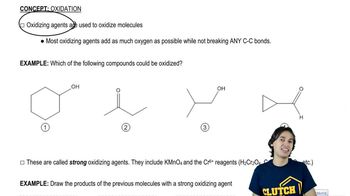
Reagents

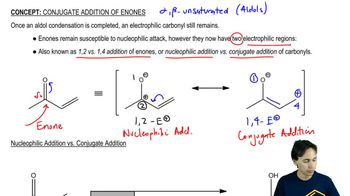
Conjugate Addition

Conjugate addition involves the addition of a nucleophile to the beta position of an alpha, beta-unsaturated carbonyl compound. Gilman reagents are particularly effective in this type of reaction, allowing for the formation of new carbon-carbon bonds while avoiding direct addition to the carbonyl group. This reaction is essential for synthesizing complex organic molecules.
Video consigliato:
09:23
1,2 vs 1,4 Addition

Cross-Coupling Reactions

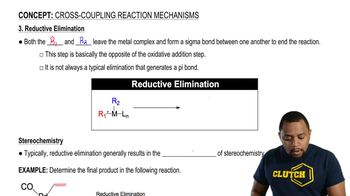
Cross-coupling reactions are a key method for forming carbon-carbon bonds, where Gilman reagents react with organic halides to create new compounds. These reactions are characterized by the transfer of organic groups from the reagent to the halide, facilitated by the copper in the Gilman reagent. Understanding the mechanism and conditions for these reactions is vital for their successful application in synthesis.
Video consigliato:
03:22
Cross-Coupling Reaction Mechanisms