Ch. 21 - Conjugated Systems 1: Stability and Addition Reactions
Mullins - Organic Chemistry: A Learner Centered Approach 1st Edition
Mullins1st EditionOrganic Chemistry: A Learner Centered ApproachISBN: 9780137566471Non è quello che usi tu?Cambia libro di testo
Capitolo 20, Problema 45a

Predict the product of the following reactions.
(a) Chemical reaction showing a conjugate addition with Ph2CuLi followed by H3O+ quench to predict the product.

Guida verificata passo dopo passo
1
Identify the type of reaction: Determine whether the reaction is an addition, elimination, substitution, or rearrangement. This will guide the prediction of the product.
Analyze the reactants: Look at the structure of the reactants involved in the reaction. Consider functional groups, stereochemistry, and any other relevant features.
Consider the reaction conditions: Reaction conditions such as temperature, solvent, and catalysts can influence the mechanism and the product formed.
Apply the mechanism: Based on the type of reaction and the conditions, apply the appropriate mechanism to predict the transformation of the reactants into products. This may involve drawing intermediates and transition states.
Verify the stereochemistry and regiochemistry: Ensure that the predicted product has the correct stereochemistry and regiochemistry, considering any chiral centers or regioselective aspects of the reaction.

Risposta video verificata per un problema simile:

Questa soluzione video è stata consigliata dai nostri tutor come utile per risolvere questo problema.
Durata del video:
1m

Concetti chiave

Ecco i concetti essenziali che devi comprendere per rispondere correttamente alla domanda.

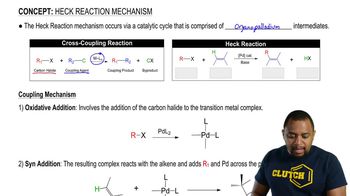
Reaction Mechanism

A reaction mechanism outlines the step-by-step process by which reactants transform into products. Understanding the mechanism is crucial for predicting the outcome of a reaction, as it involves identifying intermediates, transition states, and the movement of electrons. This concept helps in visualizing how bonds are broken and formed during the reaction.
Video consigliato:
02:16
Heck Reaction Mechanism

Functional Groups

Functional groups are specific groups of atoms within molecules that are responsible for the characteristic chemical reactions of those molecules. Recognizing these groups is essential for predicting reaction products, as they determine the reactivity and interaction of molecules. Common functional groups include alcohols, amines, carboxylic acids, and alkenes.
Video consigliato:
02:36
Identifying Functional Groups

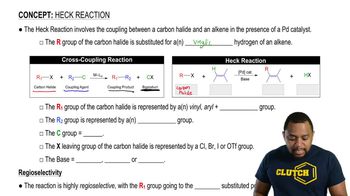
Regioselectivity and Stereoselectivity

Regioselectivity refers to the preference of a chemical reaction to occur at one direction or position over others, while stereoselectivity involves the formation of a specific stereoisomer when multiple are possible. These concepts are vital for predicting the major product of a reaction, as they dictate the orientation and arrangement of atoms in the final structure.
Video consigliato:
05:09
Heck Reaction