Ch. 21 - Conjugated Systems 1: Stability and Addition Reactions
Mullins - Organic Chemistry: A Learner Centered Approach 1st Edition
Mullins1st EditionOrganic Chemistry: A Learner Centered ApproachISBN: 9780137566471Non è quello che usi tu?Cambia libro di testo
Capitolo 20, Problema 43b

Predict the product of the following reactions.
(b) Chemical reaction diagram showing reactants and conditions for Robinson Annulation.

Guida verificata passo dopo passo
1
Identify the reaction type: The presence of KOH, H2O, and heat suggests a Claisen condensation reaction, which typically involves the formation of a β-keto ester or β-diketone.
Analyze the reactants: The first reactant is an ethyl ester of a cyclic carboxylic acid, and the second reactant is an α,β-unsaturated ketone. The ester will undergo deprotonation at the α-carbon by the strong base KOH.
Form the enolate ion: The base (KOH) will deprotonate the α-carbon of the ester, forming an enolate ion. This enolate is nucleophilic and will attack the electrophilic carbonyl carbon of the α,β-unsaturated ketone.
Perform the nucleophilic attack: The enolate ion attacks the carbonyl carbon of the α,β-unsaturated ketone, leading to the formation of a new carbon-carbon bond. This step results in the formation of a β-keto ester intermediate.
Complete the reaction: The intermediate undergoes intramolecular rearrangement and elimination of the ethoxide ion, resulting in the formation of the final product, which is a β-diketone. The reaction is driven to completion by the heat provided.

Risposta video verificata per un problema simile:

Questa soluzione video è stata consigliata dai nostri tutor come utile per risolvere questo problema.
Durata del video:
7m

Concetti chiave

Ecco i concetti essenziali che devi comprendere per rispondere correttamente alla domanda.

Reaction Mechanisms

Understanding reaction mechanisms is crucial in organic chemistry as they describe the step-by-step process by which reactants transform into products. This includes identifying intermediates, transition states, and the movement of electrons. Familiarity with mechanisms helps predict the outcome of reactions and the stability of products formed.
Video consigliato:
02:16
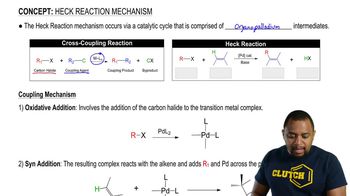
Heck Reaction Mechanism

Functional Groups

Functional groups are specific groups of atoms within molecules that are responsible for the characteristic chemical reactions of those molecules. Recognizing functional groups allows chemists to predict reactivity patterns and the types of reactions that can occur, which is essential for determining the products of a given reaction.
Video consigliato:
02:36
Identifying Functional Groups

Stereochemistry

Stereochemistry involves the study of the spatial arrangement of atoms in molecules and how this affects their chemical behavior. It is important for predicting the products of reactions, especially in cases where chirality or geometric isomerism is involved. Understanding stereochemical outcomes can significantly influence the properties and reactivity of organic compounds.
Video consigliato:
Percorso guidato
1:38
Polymer Stereochemistry Concept 1