There were actually two possible products in the solvolysis reaction from Figure 21.10. Show both products. Which would you expect to be more stable? Why?
Ch. 21 - Conjugated Systems 1: Stability and Addition Reactions

Mullins1st EditionOrganic Chemistry: A Learner Centered ApproachISBN: 9780137566471Non è quello che usi tu?Cambia libro di testo
Tutti i libri di testo
Mullins 1st Edition
Ch. 21 - Conjugated Systems 1: Stability and Addition Reactions
Problema 12
Mullins 1st Edition
Ch. 21 - Conjugated Systems 1: Stability and Addition Reactions
Problema 12Capitolo 20, Problema 12
Suppose a molecule is formed by the overlap of 16 atomic orbitals.
(a) How many molecular orbitals will be present?
(b) How many will be bonding?
(c) How many will be antibonding?
Guida verificata passo dopo passo1
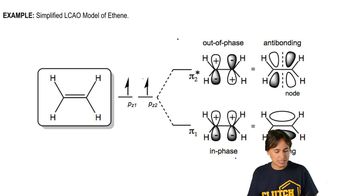
Step 1: Recall the principle of molecular orbital theory, which states that when atomic orbitals combine, they form an equal number of molecular orbitals. If 16 atomic orbitals overlap, there will be 16 molecular orbitals formed.
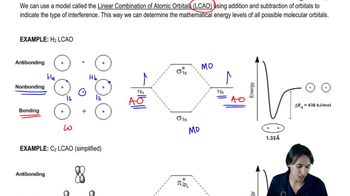
Step 2: Understand that molecular orbitals are classified as bonding, antibonding, or non-bonding. Bonding orbitals are lower in energy, while antibonding orbitals are higher in energy. Non-bonding orbitals, if present, remain at the same energy level as the atomic orbitals.
Step 3: For a simple system with no non-bonding orbitals, the molecular orbitals are evenly split into bonding and antibonding orbitals. Therefore, half of the molecular orbitals will be bonding, and the other half will be antibonding.
Step 4: Calculate the number of bonding orbitals by dividing the total number of molecular orbitals by 2. For 16 molecular orbitals, the number of bonding orbitals is 16 ÷ 2 = 8.
Step 5: Similarly, calculate the number of antibonding orbitals, which is also 16 ÷ 2 = 8. Thus, there are 8 bonding orbitals and 8 antibonding orbitals in this system.

Risposta video verificata per un problema simile:
Questa soluzione video è stata consigliata dai nostri tutor come utile per risolvere questo problema.
Durata del video:
2mConcetti chiave
Ecco i concetti essenziali che devi comprendere per rispondere correttamente alla domanda.
Molecular Orbital Theory
Molecular Orbital Theory explains how atomic orbitals combine to form molecular orbitals, which can be occupied by electrons. When atomic orbitals overlap, they create a number of molecular orbitals equal to the number of atomic orbitals combined. These molecular orbitals can be classified as bonding or antibonding based on their energy levels and stability.
Video consigliato:
Review of Molecular Orbitals
Bonding and Antibonding Orbitals
Bonding orbitals are formed when atomic orbitals combine constructively, leading to a lower energy state and increased stability for the molecule. In contrast, antibonding orbitals result from destructive interference of atomic orbitals, resulting in a higher energy state that destabilizes the molecule. The number of bonding and antibonding orbitals can be determined based on the specific interactions of the atomic orbitals involved.
Video consigliato:
What’s the difference between atomic and molecular orbitals?
Conservation of Orbitals
The principle of conservation of orbitals states that the total number of molecular orbitals formed is equal to the total number of atomic orbitals that combine. For example, if 16 atomic orbitals overlap, 16 molecular orbitals will be created. These can be further divided into bonding and antibonding orbitals, typically with half being bonding and half being antibonding, depending on the specific molecular structure.
Video consigliato:
Review of Molecular Orbitals
Pratica correlata
Domanda del libro di testo
1241
views
Domanda del libro di testo
The molecular orbital picture of H2 can be represented by the following diagram. Label σ and σ* on the diagram—that is, which is (a) and which is (b)? Which is lower in energy? Why?
<IMAGE>
1326
views
Domanda del libro di testo
p-Nitrophenol (pKa = 7.2) is ten times more acidic than m-nitrophenol (pKa = 8.4) Explain.
2576
views
Domanda del libro di testo
Hexa-1,3,5-triene uses six p orbitals, each containing a single electron, to make its three π bonds. How many total molecular orbitals are made by the six p orbitals?
1625
views
Domanda del libro di testo
Why is this not a viable representation of the ψ2, molecular orbital of buta-1,3-diene?
1104
views
Domanda del libro di testo
Hydroboration, an electrophilic addition reaction like those studied in Section 21.4, only gives 1,2-addition to buta-1,3-diene, regardless of temperature. Why?
1375
views