Ch. 21 - Conjugated Systems 1: Stability and Addition Reactions
Mullins - Organic Chemistry: A Learner Centered Approach 1st Edition
Mullins1st EditionOrganic Chemistry: A Learner Centered ApproachISBN: 9780137566471Non è quello che usi tu?Cambia libro di testo
Capitolo 20, Problema 16

Why is this not a viable representation of the ψ2, molecular orbital of buta-1,3-diene?

Guida verificata passo dopo passo
1
Step 1: Understand the molecular orbital ψ₂ of buta-1,3-diene. Buta-1,3-diene has four π molecular orbitals (ψ₁, ψ₂, ψ₃, ψ₄) formed by the combination of four p orbitals from the conjugated system. ψ₂ is the second-lowest energy molecular orbital and has one node where the phase of the p orbitals changes.
Step 2: Analyze the image provided. The image shows a representation of p orbitals with alternating phases (+ and -) along the conjugated system. However, the pattern of phases does not correspond to the expected configuration of ψ₂.
Step 3: Recall the characteristics of ψ₂. In ψ₂, there should be one node (a region where the wavefunction changes sign) between the p orbitals. This node divides the molecule into two regions with opposite phases. The image provided does not show a single node; instead, it shows multiple phase changes, which is inconsistent with ψ₂.
Step 4: Compare the image to the correct representation of ψ₂. The correct representation of ψ₂ should have one node, with two p orbitals on one side of the node having the same phase and the other two p orbitals on the opposite side having the opposite phase. The image provided does not match this description.
Step 5: Conclude why the representation is not viable. The image fails to accurately depict the single node and phase distribution characteristic of ψ₂. Instead, it shows an incorrect arrangement of phases, making it an invalid representation of the ψ₂ molecular orbital of buta-1,3-diene.

Risposta video verificata per un problema simile:

Questa soluzione video è stata consigliata dai nostri tutor come utile per risolvere questo problema.
Durata del video:
5m

Concetti chiave

Ecco i concetti essenziali che devi comprendere per rispondere correttamente alla domanda.

Molecular Orbitals

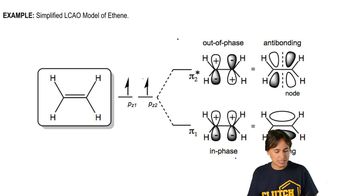
Molecular orbitals (MOs) are formed by the linear combination of atomic orbitals (LCAO) when atoms bond together. In buta-1,3-diene, the π molecular orbitals arise from the overlap of p orbitals on adjacent carbon atoms. Understanding the arrangement and energy levels of these MOs is crucial for analyzing the stability and reactivity of the molecule.
Video consigliato:
08:41
Review of Molecular Orbitals

Node Concept

Nodes are regions in a molecular orbital where the probability of finding an electron is zero. In the context of buta-1,3-diene, the presence of nodes in the π molecular orbitals indicates the distribution of electron density. A viable representation of the ψ₂ orbital must accurately depict the number and placement of nodes, which affects the orbital's energy and stability.
Video consigliato:
Percorso guidato
1:21
The Citric Acid Cycle Concept 10

Charge Distribution

Charge distribution refers to how electron density is spread across a molecule's orbitals. In buta-1,3-diene, the charge distribution in the π molecular orbitals influences the molecule's reactivity and stability. An accurate representation must show how positive and negative charges are distributed, particularly in the context of resonance structures and the overall electronic configuration.
Video consigliato:
01:34
Calculating formal and net charge.