Ch. 21 - Conjugated Systems 1: Stability and Addition Reactions
Mullins - Organic Chemistry: A Learner Centered Approach 1st Edition
Mullins1st EditionOrganic Chemistry: A Learner Centered ApproachISBN: 9780137566471Non è quello che usi tu?Cambia libro di testo
Capitolo 20, Problema 18

Which of the following would you expect to be a more stable molecular orbital? Why?
<IMAGE>

Guida verificata passo dopo passo
1
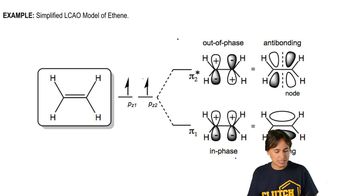
Step 1: Analyze the molecular orbital diagrams provided in the image. Diagram (I) shows a bonding molecular orbital where the lobes of the atomic orbitals overlap constructively (same phase, indicated by matching signs). Diagram (II) shows an antibonding molecular orbital where the lobes of the atomic orbitals overlap destructively (opposite phases, indicated by opposite signs).
Step 2: Recall the concept of molecular orbital stability. Bonding molecular orbitals are more stable because constructive overlap leads to increased electron density between the nuclei, which stabilizes the molecule. Antibonding molecular orbitals are less stable because destructive overlap reduces electron density between the nuclei, leading to repulsion.
Step 3: Examine the phase alignment in Diagram (I). The constructive overlap of orbitals in the bonding molecular orbital results in a lower energy state, making it more stable.
Step 4: Examine the phase alignment in Diagram (II). The destructive overlap of orbitals in the antibonding molecular orbital results in a higher energy state, making it less stable.
Step 5: Conclude that the bonding molecular orbital (Diagram I) is more stable than the antibonding molecular orbital (Diagram II) due to the constructive overlap of atomic orbitals, which increases electron density between the nuclei and lowers the energy of the system.

Risposta video verificata per un problema simile:

Questa soluzione video è stata consigliata dai nostri tutor come utile per risolvere questo problema.
Durata del video:
6m

Concetti chiave

Ecco i concetti essenziali che devi comprendere per rispondere correttamente alla domanda.

Molecular Orbital Theory

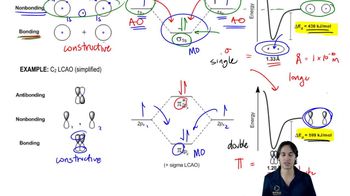
Molecular Orbital Theory describes how atomic orbitals combine to form molecular orbitals, which can be occupied by electrons. These molecular orbitals can be bonding, antibonding, or non-bonding, influencing the stability of the molecule. The stability of a molecular orbital is determined by the energy levels and the overlap of the atomic orbitals involved in its formation.
Video consigliato:
08:41
Review of Molecular Orbitals

Bonding vs. Antibonding Orbitals

Bonding orbitals are formed when atomic orbitals combine constructively, resulting in a lower energy state and increased stability for the molecule. In contrast, antibonding orbitals arise from destructive interference, leading to a higher energy state and decreased stability. The presence of electrons in bonding orbitals contributes to molecular stability, while electrons in antibonding orbitals can destabilize the molecule.
Video consigliato:
03:25
Sigma bond vs. pi bond, which is stronger?

Electron Configuration in Molecular Orbitals

The electron configuration in molecular orbitals follows the Aufbau principle, where electrons fill the lowest energy orbitals first. The stability of a molecular orbital can be assessed by counting the number of electrons in bonding versus antibonding orbitals. A greater number of electrons in bonding orbitals compared to antibonding orbitals indicates a more stable molecular configuration.
Video consigliato:
04:12
The Electron Configuration