Ch. 22 - Conjugated Systems 2: Pericyclic Reactions
Mullins - Organic Chemistry: A Learner Centered Approach 1st Edition
Mullins1st EditionOrganic Chemistry: A Learner Centered ApproachISBN: 9780137566471Non è quello che usi tu?Cambia libro di testo
Capitolo 21, Problema 38c

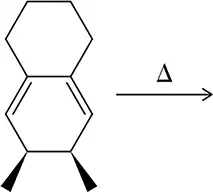
Given the conditions, would you expect conrotatory or disrotatory ring closing/opening? Justify this on the basis of the molecular orbital picture.
(c) Chemical structure illustrating a ring system with arrows indicating potential conrotatory or disrotatory transitions.

Guida verificata passo dopo passo
1
Identify the type of pericyclic reaction involved. In this case, it is a ring-closing reaction of a hexatriene system, which is a type of electrocyclic reaction.
Determine the number of π-electrons involved in the system. The hexatriene system has 6 π-electrons.
Apply the Woodward-Hoffmann rules for electrocyclic reactions. For a thermal reaction involving 4n π-electrons (where n is an integer), the reaction proceeds via a conrotatory mechanism.
Visualize the molecular orbitals involved. In a conrotatory process, the terminal p orbitals rotate in the same direction, either both clockwise or both counterclockwise, to form the new σ-bond.
Justify the mechanism based on the symmetry of the highest occupied molecular orbital (HOMO). For 6 π-electrons, the HOMO is symmetric, which supports a conrotatory closure under thermal conditions.

Risposta video verificata per un problema simile:

Questa soluzione video è stata consigliata dai nostri tutor come utile per risolvere questo problema.

Concetti chiave

Ecco i concetti essenziali che devi comprendere per rispondere correttamente alla domanda.

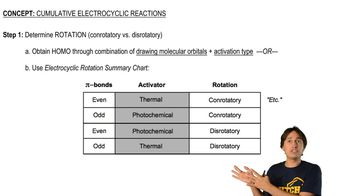
Conrotatory and Disrotatory Motion

Conrotatory and disrotatory motions describe the stereochemical outcomes of electrocyclic reactions. In conrotatory motion, the substituents at the termini of the reacting pi system rotate in the same direction, while in disrotatory motion, they rotate in opposite directions. The type of motion depends on the number of pi electrons and whether the reaction is thermal or photochemical.
Video consigliato:
05:51
Two Steps to Predicting Any Electrocyclic Products

Woodward-Hoffmann Rules

The Woodward-Hoffmann rules predict the stereochemistry of pericyclic reactions, including electrocyclic reactions, based on the conservation of orbital symmetry. For thermal reactions, a system with 4n pi electrons undergoes conrotatory closure, while a system with 4n+2 pi electrons undergoes disrotatory closure. These rules help determine the stereochemical outcome of the reaction.
Video consigliato:
Percorso guidato
1:18
Woodward-Fieser Rules Example 1

Molecular Orbital Theory

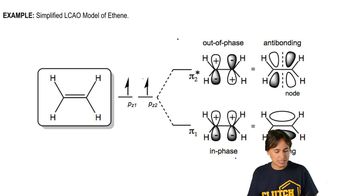
Molecular orbital (MO) theory explains the behavior of electrons in molecules in terms of orbitals that extend over the entire molecule. In electrocyclic reactions, the symmetry and phase of the frontier molecular orbitals (HOMO and LUMO) determine the allowed stereochemical pathway. The interaction of these orbitals during the reaction dictates whether the process is conrotatory or disrotatory.
Video consigliato:
08:41
Review of Molecular Orbitals