
Ch. 22 - Conjugated Systems 2: Pericyclic Reactions
Mullins - Organic Chemistry: A Learner Centered Approach 1st Edition
Mullins1st EditionOrganic Chemistry: A Learner Centered ApproachISBN: 9780137566471Non è quello che usi tu?Cambia libro di testo
Capitolo 21, Problema 54b

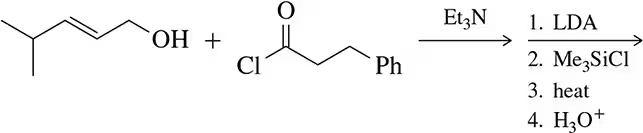
Only after working Assessment 22.53, predict the product of the following reactions.
(b) Chemical reaction diagram showing reactants and steps for predicting product formation.

Guida verificata passo dopo passo
1
Identify the reactants: The first reactant is an allylic alcohol, and the second reactant is an acid chloride with a phenyl group.
Step 1 involves the use of LDA (Lithium diisopropylamide), a strong base, which will deprotonate the alcohol to form an alkoxide ion. This step is crucial for the subsequent reaction steps.
Step 2 involves the use of Me3SiCl (Trimethylsilyl chloride), which will protect the alkoxide ion by forming a silyl ether. This protection is necessary to prevent unwanted side reactions.
Step 3 involves heating the reaction mixture. This step is likely to facilitate the nucleophilic attack of the silyl-protected alcohol on the carbonyl carbon of the acid chloride, leading to the formation of an ester linkage.
Step 4 involves the addition of H3O+ (acidic workup), which will remove the silyl protecting group, regenerating the alcohol functionality in the final product.

Risposta video verificata per un problema simile:

Questa soluzione video è stata consigliata dai nostri tutor come utile per risolvere questo problema.

Concetti chiave

Ecco i concetti essenziali che devi comprendere per rispondere correttamente alla domanda.

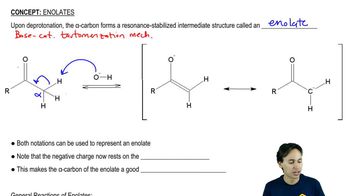
Enolate Formation

Enolate formation is a key step in many organic reactions, involving the deprotonation of an alpha hydrogen adjacent to a carbonyl group. In this reaction, LDA (lithium diisopropylamide) acts as a strong base to deprotonate the alpha position of the carbonyl compound, generating an enolate ion. This enolate can then act as a nucleophile in subsequent steps.
Video consigliato:
02:26
Formation of Enolates

Silyl Ether Protection

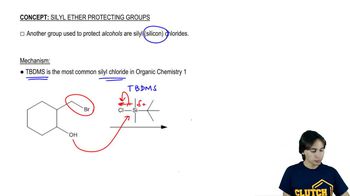
Silyl ether protection involves the conversion of an alcohol into a silyl ether, which is more stable and less reactive under certain conditions. In this reaction, Me3SiCl (trimethylsilyl chloride) is used to protect the hydroxyl group of the alcohol, preventing it from interfering in the reaction. This protection is crucial for controlling the reactivity and selectivity of the reaction.
Video consigliato:
07:16
Mechanism of Silyl Ether Protecting Groups.

Aldol Condensation

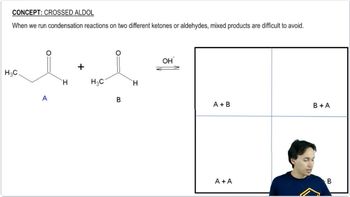
Aldol condensation is a reaction where an enolate ion reacts with a carbonyl compound to form a β-hydroxy ketone or aldehyde, followed by dehydration to yield an α,β-unsaturated carbonyl compound. In this reaction, the enolate formed initially can attack the carbonyl carbon of the other reactant, leading to the formation of a new carbon-carbon bond, which is then followed by dehydration upon heating.
Video consigliato:
09:51
Crossed Aldol
Pratica correlata
Domanda del libro di testo

The Claisen rearrangement can be used to attach allyl groups to benzene via initial alkylation of a phenol.

(a) Predict the identity of A and B

(b) provide an arrow-pushing mechanism for each step. [The phenol alkylation is simply a Williamson ether synthesis reaction.]


631
views
Domanda del libro di testo

The Eschenmoser–Claisen reaction is a variant of the Claisen reaction studied in this chapter. Based on your answers to Assessments 22.53–22.55, predict a product of this reaction.

554
views
Domanda del libro di testo

In Chapter 20, we studied the aldol reaction. Although not discussed at the time, this reaction is stereospecific, proceeding through the Zimmerman–Traxler transition state shown here.

(a) Show an arrow-pushing mechanism for this concerted reaction.

(b) Why is this a favorable mechanism?

678
views
Domanda del libro di testo

Only after working Assessment 22.53, predict the product of the following reactions.

(a)

664
views
Domanda del libro di testo

The Ireland–Claisen reaction is a variant of the Claisen reaction studied in this chapter.

(a) Suggest a mechanism for the first step.

(b) Predict the product (B) that would result from heating intermediate A.

(c) Hydrolysis of B gives a carboxylic acid.

Suggest a mechanism for this reaction.

760
views
Domanda del libro di testo

The Johnson–Claisen reaction is a variant of the Claisen reaction studied in this chapter. (a) Suggest a mechanism for the first step. (b) Predict the product (B) that would result from heating intermediate A.

648
views