Ch. 22 - Conjugated Systems 2: Pericyclic Reactions
Mullins - Organic Chemistry: A Learner Centered Approach 1st Edition
Mullins1st EditionOrganic Chemistry: A Learner Centered ApproachISBN: 9780137566471Non è quello che usi tu?Cambia libro di testo
Capitolo 21, Problema 55

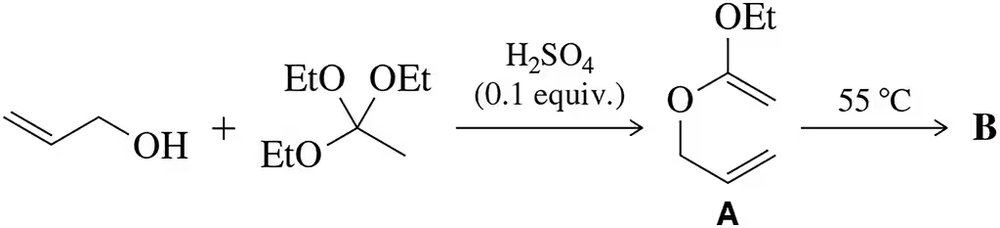
The Johnson–Claisen reaction is a variant of the Claisen reaction studied in this chapter. (a) Suggest a mechanism for the first step. (b) Predict the product (B) that would result from heating intermediate A.
Chemical reaction diagram showing reactants, intermediate A, and product B with conditions for the Johnson–Claisen reaction.

Guida verificata passo dopo passo
1
The Johnson–Claisen rearrangement involves the conversion of an allylic alcohol to an allylic ester. In the first step, the allylic alcohol reacts with the orthoester in the presence of a catalytic amount of acid (H2SO4) to form an intermediate hemiacetal.
The acid catalyzes the formation of the hemiacetal by protonating the orthoester, making it more electrophilic and susceptible to nucleophilic attack by the alcohol.
Once the hemiacetal is formed, it undergoes a rearrangement. The allylic group migrates to the oxygen atom, forming a new carbon-oxygen bond and resulting in the formation of an enol ether intermediate (A).
Upon heating, the enol ether intermediate (A) undergoes a [3,3]-sigmatropic rearrangement, which is characteristic of the Claisen rearrangement. This rearrangement involves the migration of the allylic group and the formation of a new carbon-carbon bond.
The final product (B) is an allylic ester, which is formed after the rearrangement and subsequent tautomerization of the enol ether intermediate.

Risposta video verificata per un problema simile:

Questa soluzione video è stata consigliata dai nostri tutor come utile per risolvere questo problema.

Concetti chiave

Ecco i concetti essenziali che devi comprendere per rispondere correttamente alla domanda.

Johnson–Claisen Reaction

The Johnson–Claisen reaction is a variant of the Claisen rearrangement, involving the conversion of allylic alcohols into γ,δ-unsaturated carbonyl compounds. This reaction typically involves the use of an orthoester and an acid catalyst, leading to the formation of an intermediate enol ether, which rearranges to form the final product. Understanding this reaction is crucial for predicting the transformation of intermediate A to product B.
Video consigliato:
02:10
Claisen-Schmidt Reaction

Mechanism of the Johnson–Claisen Reaction

The mechanism begins with the protonation of the orthoester by the acid catalyst, followed by nucleophilic attack by the allylic alcohol, leading to the formation of an enol ether intermediate. This intermediate undergoes a [3,3]-sigmatropic rearrangement, resulting in the formation of a γ,δ-unsaturated carbonyl compound. Recognizing these steps helps in suggesting the mechanism for the first step of the reaction.
Video consigliato:
02:10
Claisen-Schmidt Reaction

Sigmatropic Rearrangement

A sigmatropic rearrangement is a pericyclic reaction where a sigma bond adjacent to one or more pi systems migrates across the pi system. In the Johnson–Claisen reaction, a [3,3]-sigmatropic rearrangement occurs, where the enol ether intermediate rearranges to form a new carbon-carbon bond, leading to the formation of the final product. This concept is essential for predicting the structure of product B from intermediate A.
Video consigliato:
03:20
Nomenclature of Sigmatropic Shifts
Pratica correlata
Domanda del libro di testo

The Eschenmoser–Claisen reaction is a variant of the Claisen reaction studied in this chapter. Based on your answers to Assessments 22.53–22.55, predict a product of this reaction.

554
views

Domanda del libro di testo

In Chapter 20, we studied the aldol reaction. Although not discussed at the time, this reaction is stereospecific, proceeding through the Zimmerman–Traxler transition state shown here.

(a) Show an arrow-pushing mechanism for this concerted reaction.

(b) Why is this a favorable mechanism?

678
views
Domanda del libro di testo

Only after working Assessment 22.53, predict the product of the following reactions.

(b)

566
views
Domanda del libro di testo

Only after working Assessment 22.53, predict the product of the following reactions.

(a)

664
views
Domanda del libro di testo

The Ireland–Claisen reaction is a variant of the Claisen reaction studied in this chapter.

(a) Suggest a mechanism for the first step.

(b) Predict the product (B) that would result from heating intermediate A.

(c) Hydrolysis of B gives a carboxylic acid.

Suggest a mechanism for this reaction.

760
views
Domanda del libro di testo

While not covered explicitly in this chapter, the ene reaction occurs similarly to the Diels–Alder reaction but replaces the electrons from one bond in the diene with the electrons in a C―H bond. Draw the mechanism for the following reaction. [Number the carbons and draw in the hydrogens of the product. And, of course, make a note of bonds formed and bonds broken.]

995
views