Ch. 22 - Conjugated Systems 2: Pericyclic Reactions
Mullins - Organic Chemistry: A Learner Centered Approach 1st Edition
Mullins1st EditionOrganic Chemistry: A Learner Centered ApproachISBN: 9780137566471Non è quello che usi tu?Cambia libro di testo
Capitolo 21, Problema 41c

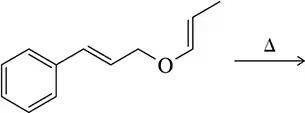
Predict the product of the Claisen reactions shown.
(c) Chemical structure of allyl vinyl ether with an arrow indicating heat, suggesting a Claisen rearrangement reaction.

Guida verificata passo dopo passo
1
Identify the reactants involved in the Claisen reaction. Typically, a Claisen condensation involves two ester molecules or an ester and a ketone.
Determine the base used in the reaction. Commonly, a strong base like sodium ethoxide (NaOEt) is used to deprotonate the alpha hydrogen of the ester.
Recognize the formation of the enolate ion. The base abstracts an alpha hydrogen from the ester, forming an enolate ion, which is a key intermediate in the Claisen condensation.
Consider the nucleophilic attack. The enolate ion acts as a nucleophile and attacks the carbonyl carbon of another ester molecule, leading to the formation of a tetrahedral intermediate.
Identify the final product. The tetrahedral intermediate collapses, resulting in the elimination of an alkoxide ion and forming a β-keto ester as the final product of the Claisen condensation.

Risposta video verificata per un problema simile:

Questa soluzione video è stata consigliata dai nostri tutor come utile per risolvere questo problema.
Durata del video:
15m

Concetti chiave

Ecco i concetti essenziali che devi comprendere per rispondere correttamente alla domanda.

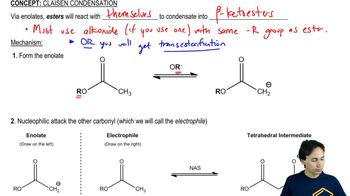
Claisen Condensation

Claisen condensation is a reaction where two esters or one ester and a ketone react in the presence of a strong base to form a β-keto ester or a β-diketone. The reaction involves the formation of an enolate ion from one of the ester molecules, which then attacks the carbonyl carbon of another ester, leading to the formation of a new carbon-carbon bond.
Video consigliato:
08:28
Claisen Condensation

Enolate Ion Formation

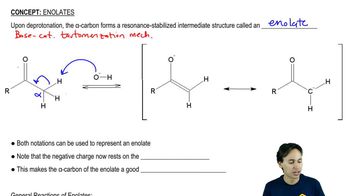
Enolate ions are formed when a strong base deprotonates the α-hydrogen of an ester or ketone, resulting in a resonance-stabilized anion. This ion is nucleophilic and can attack electrophilic centers, such as the carbonyl carbon in Claisen condensation, facilitating the formation of new carbon-carbon bonds.
Video consigliato:
02:26
Formation of Enolates

Product Prediction in Claisen Reaction

Predicting the product of a Claisen reaction involves identifying the nucleophilic enolate ion and the electrophilic carbonyl carbon. The enolate ion attacks the carbonyl carbon, forming a new C-C bond and resulting in a β-keto ester or β-diketone. Understanding the structure of reactants and the mechanism helps in predicting the final product accurately.
Video consigliato:
02:10
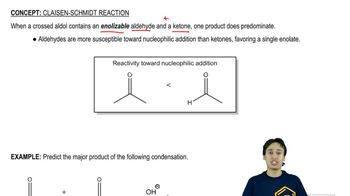
Claisen-Schmidt Reaction