Ch. 23 - Benzene 1: Aromatic Stability and Substitution Reactions
Mullins - Organic Chemistry: A Learner Centered Approach 1st Edition
Mullins1st EditionOrganic Chemistry: A Learner Centered ApproachISBN: 9780137566471Non è quello che usi tu?Cambia libro di testo
Capitolo 22, Problema 58

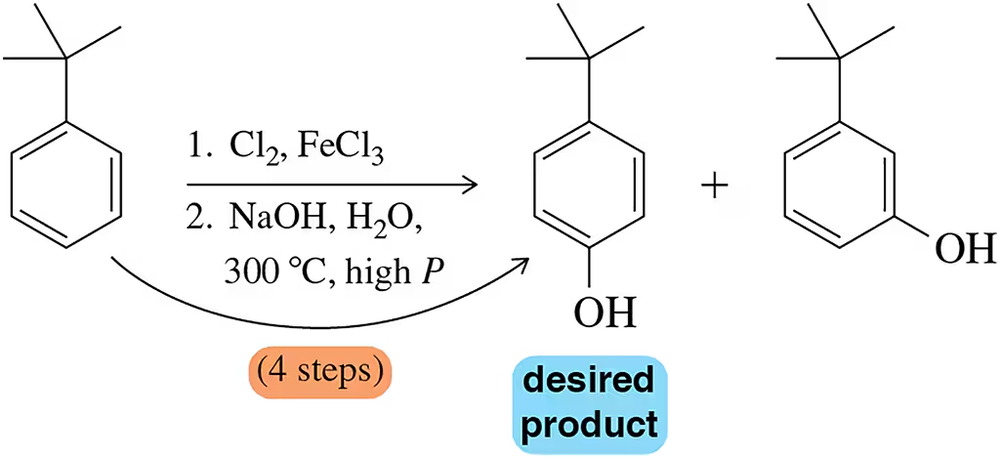
Conversion of t-butylbenzene to a phenol results in two products when the reaction occurs through the benzyne mechanism. Devise a sequence involving a diazonium ion in which only one phenol product is produced.
Diagram illustrating a chemical reaction sequence converting t-butylbenzene to a phenol, highlighting steps and products.

Guida verificata passo dopo passo
1
Begin by converting t-butylbenzene to a diazonium salt. First, perform a nitration reaction by treating t-butylbenzene with concentrated HNO3 and H2SO4 to introduce a nitro group on the benzene ring.
Reduce the nitro group to an amino group using a reducing agent such as Sn/HCl or Fe/HCl, resulting in t-butylaniline.
Convert the amino group to a diazonium ion by treating t-butylaniline with NaNO2 and HCl at 0-5°C. This forms the diazonium salt, t-butylbenzenediazonium chloride.
Perform a Sandmeyer reaction by treating the diazonium salt with Cu2O in water, which will replace the diazonium group with a hydroxyl group, forming the desired phenol product.
This sequence ensures that only one phenol product is formed, avoiding the formation of multiple isomers as seen in the benzyne mechanism.

Risposta video verificata per un problema simile:

Questa soluzione video è stata consigliata dai nostri tutor come utile per risolvere questo problema.

Concetti chiave

Ecco i concetti essenziali che devi comprendere per rispondere correttamente alla domanda.

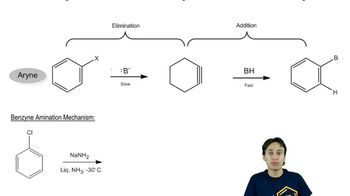
Benzyne Mechanism

The benzyne mechanism is a reaction pathway involving the formation of a highly reactive intermediate known as benzyne. This intermediate is generated by the elimination of a leaving group from a benzene derivative, leading to a triple bond between two carbon atoms in the aromatic ring. The reactivity of benzyne allows for various nucleophilic attacks, which can result in multiple products, complicating the synthesis of a single desired product.
Video consigliato:
06:06
General Mechanism

Diazonium Ion

Diazonium ions are highly reactive intermediates formed from primary aromatic amines and nitrous acid. They are characterized by the presence of a positively charged nitrogen atom bonded to a benzene ring. In organic synthesis, diazonium ions can undergo various transformations, including coupling reactions, which can be strategically used to introduce functional groups like hydroxyl groups, leading to the formation of phenols in a controlled manner.
Video consigliato:
Percorso guidato
3:39
Metal Ion Catalysis Concept 1

Electrophilic Aromatic Substitution

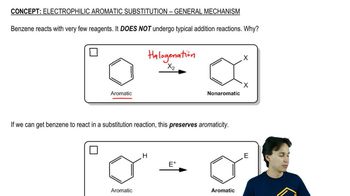
Electrophilic aromatic substitution (EAS) is a fundamental reaction in organic chemistry where an electrophile replaces a hydrogen atom on an aromatic ring. This process typically involves the generation of a sigma complex, followed by deprotonation to restore aromaticity. In the context of converting t-butylbenzene to phenol, EAS can be utilized to introduce functional groups selectively, allowing for the synthesis of a single phenol product when combined with subsequent reactions involving diazonium ions.
Video consigliato:
03:07
EAS Review