Ch. 23 - Benzene 1: Aromatic Stability and Substitution Reactions
Mullins - Organic Chemistry: A Learner Centered Approach 1st Edition
Mullins1st EditionOrganic Chemistry: A Learner Centered ApproachISBN: 9780137566471Non è quello che usi tu?Cambia libro di testo
Capitolo 22, Problema 59b

Predict the products of the following reactions.
(b) Chemical reaction diagram illustrating the Negishi coupling with reactants, reagents, and products indicated.

Guida verificata passo dopo passo
1
Identify the type of reaction: The reaction involves an aryl iodide and an organozinc reagent in the presence of a palladium catalyst, indicating a Negishi coupling reaction.
Understand the role of each component: The aryl iodide will act as the electrophile, while the organozinc compound will serve as the nucleophile. The palladium catalyst facilitates the coupling process.
Predict the coupling: In a Negishi coupling, the carbon atom bonded to the zinc in the organozinc reagent will form a new bond with the carbon atom bonded to the iodine in the aryl iodide.
Consider the regioselectivity: The reaction will proceed with the formation of a new carbon-carbon bond between the aryl group and the alkyl chain from the organozinc reagent, replacing the iodine atom.
Draw the product: The final product will be a compound where the aryl group is directly connected to the alkyl chain, with the iodine atom replaced by the alkyl group from the organozinc reagent.

Risposta video verificata per un problema simile:

Questa soluzione video è stata consigliata dai nostri tutor come utile per risolvere questo problema.
Durata del video:
3m

Concetti chiave

Ecco i concetti essenziali che devi comprendere per rispondere correttamente alla domanda.

Negishi Coupling

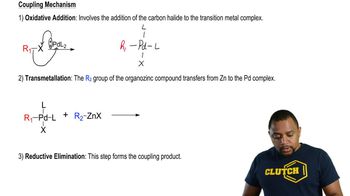
Negishi coupling is a cross-coupling reaction that forms carbon-carbon bonds between an organozinc compound and an organic halide, typically catalyzed by palladium. This reaction is highly useful in organic synthesis for constructing complex molecules. The presence of a palladium catalyst, such as Pd(PPh3)4, facilitates the transfer of the organic group from zinc to the halide, resulting in the formation of a new C-C bond.
Video consigliato:
03:18
Negishi Coupling Reaction

Role of Palladium Catalyst

Palladium catalysts, like Pd(PPh3)4, play a crucial role in facilitating cross-coupling reactions by enabling the oxidative addition of the organic halide and the subsequent transmetalation with the organozinc reagent. The catalyst undergoes a series of redox cycles, allowing the coupling partners to form a new carbon-carbon bond efficiently. The choice of ligand, such as triphenylphosphine (PPh3), can influence the reaction's selectivity and rate.
Video consigliato:
Percorso guidato
3:21
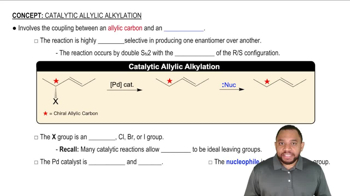
Catalytic Allylic Alkylation Concept 1

Organozinc Reagents

Organozinc reagents, such as the ZnBr-alkene shown in the reaction, are nucleophilic species used in cross-coupling reactions like Negishi coupling. They are known for their relatively mild reactivity and compatibility with a wide range of functional groups. In the reaction, the organozinc compound donates its organic group to the palladium catalyst, which then couples it with the organic halide to form the desired product.
Video consigliato:
01:52
Reagents