Ch. 23 - Benzene 1: Aromatic Stability and Substitution Reactions
Mullins - Organic Chemistry: A Learner Centered Approach 1st Edition
Mullins1st EditionOrganic Chemistry: A Learner Centered ApproachISBN: 9780137566471Non è quello che usi tu?Cambia libro di testo
Capitolo 22, Problema 27b

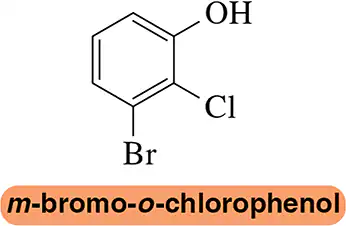
Convert the given name into the corresponding IUPAC name.
(b) Chemical structure of m-bromo-o-chlorophenol with Br, Cl, and OH groups on a benzene ring.

Guida verificata passo dopo passo
1
Identify the parent compound: The parent compound in this structure is phenol, which is a benzene ring with a hydroxyl group (OH) attached.
Number the carbon atoms in the benzene ring: Start numbering from the carbon atom attached to the hydroxyl group (OH) as it is the highest priority functional group. Assign it as carbon 1.
Locate the substituents: Identify the positions of the bromo (Br) and chloro (Cl) groups on the benzene ring. The bromo group is on carbon 3 and the chloro group is on carbon 2.
Assign the IUPAC name: Combine the substituents with their respective positions and the parent compound. The IUPAC name is formed by listing the substituents in alphabetical order with their position numbers, followed by the name of the parent compound.
Construct the final IUPAC name: The IUPAC name for the compound is 2-chloro-3-bromophenol, reflecting the positions and identities of the substituents on the phenol ring.

Risposta video verificata per un problema simile:

Questa soluzione video è stata consigliata dai nostri tutor come utile per risolvere questo problema.

Concetti chiave

Ecco i concetti essenziali che devi comprendere per rispondere correttamente alla domanda.

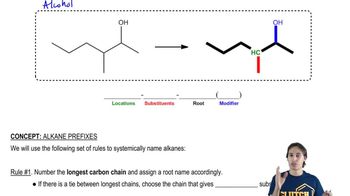
IUPAC Nomenclature

IUPAC nomenclature is a systematic method of naming organic chemical compounds as recommended by the International Union of Pure and Applied Chemistry. It provides a standardized way to name chemical substances, ensuring that each name is unique and universally understood. The rules involve identifying the longest carbon chain, numbering the chain to give substituents the lowest possible numbers, and naming substituents as prefixes.
Video consigliato:
03:43
The different parts of an IUPAC name

Aromatic Compounds

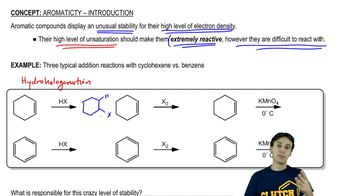
Aromatic compounds, such as benzene, are characterized by their stable ring structure with alternating double bonds, known as aromaticity. This stability arises from the delocalization of electrons across the ring, which follows Huckel's rule. In the context of naming, the presence of a benzene ring often serves as the parent structure, with substituents named as prefixes.
Video consigliato:
08:19
Intro to Aromaticity

Substituent Positioning on Benzene Rings

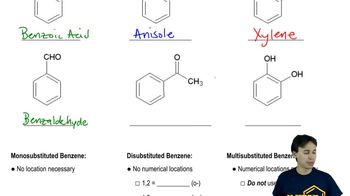
In benzene derivatives, substituents are often described by their relative positions on the ring: ortho (o-), meta (m-), and para (p-). 'Ortho' indicates adjacent positions, 'meta' indicates one carbon between substituents, and 'para' indicates opposite positions. In IUPAC naming, these positions are indicated by numbers, with the hydroxyl group (OH) often taking priority as the main functional group.
Video consigliato:
09:04
Benzene Nomenclature