Ch. 23 - Benzene 1: Aromatic Stability and Substitution Reactions
Mullins - Organic Chemistry: A Learner Centered Approach 1st Edition
Mullins1st EditionOrganic Chemistry: A Learner Centered ApproachISBN: 9780137566471Non è quello che usi tu?Cambia libro di testo
Capitolo 22, Problema 29f

Classify the following conjugated systems as having 4n or 4n + 2 π electrons.
(f) Chemical structure of a conjugated system with a benzene ring and two vinyl groups, illustrating π electron distribution.

Guida verificata passo dopo passo
1
Identify the conjugated system in the given molecule. A conjugated system typically consists of alternating single and multiple bonds, which allows for the delocalization of π electrons.
Count the number of π electrons present in the conjugated system. Remember that each double bond contributes 2 π electrons, and lone pairs or negative charges on atoms in conjugated systems can also contribute π electrons.
Apply Hückel's rule to determine the aromaticity of the system. Hückel's rule states that a planar, cyclic, conjugated system is aromatic if it contains 4n + 2 π electrons, where n is a non-negative integer.
If the system has 4n π electrons, it is classified as antiaromatic. Antiaromatic systems are less stable due to the lack of aromatic stabilization.
Conclude the classification by determining whether the system has 4n or 4n + 2 π electrons based on your count and analysis. This will help in understanding the stability and reactivity of the molecule.

Risposta video verificata per un problema simile:

Questa soluzione video è stata consigliata dai nostri tutor come utile per risolvere questo problema.

Concetti chiave

Ecco i concetti essenziali che devi comprendere per rispondere correttamente alla domanda.

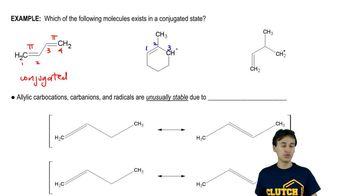
Conjugated Systems

Conjugated systems in organic chemistry refer to molecules with alternating single and multiple bonds, allowing for delocalization of π electrons across the structure. This delocalization stabilizes the molecule and affects its chemical properties, such as color and reactivity. Understanding conjugation is crucial for analyzing electron distribution in these systems.
Video consigliato:
03:27
Conjugated states

Hückel's Rule

Hückel's Rule is a principle used to determine the aromaticity of cyclic conjugated systems. It states that a molecule is aromatic if it contains (4n + 2) π electrons, where n is a non-negative integer. Aromatic compounds are particularly stable due to electron delocalization, and this rule helps classify them based on their electron count.
Video consigliato:
03:54
The 18 and 16 Electron Rule

4n π Electron Systems

Systems with 4n π electrons, where n is an integer, are typically non-aromatic and less stable compared to those following Hückel's Rule. These systems do not benefit from the same level of electron delocalization and stabilization as aromatic compounds, making them more reactive and less chemically stable.
Video consigliato:
03:54
The 18 and 16 Electron Rule