
Ch. 23 - Benzene 1: Aromatic Stability and Substitution Reactions
Mullins - Organic Chemistry: A Learner Centered Approach 1st Edition
Mullins1st EditionOrganic Chemistry: A Learner Centered ApproachISBN: 9780137566471Non è quello che usi tu?Cambia libro di testo
Capitolo 22, Problema 61f

(i) Classify the following molecules as aromatic, nonaromatic, or antiaromatic.
(ii) For aromatic molecules, solve for n in Hückel’s rule. For all other molecules, explain which rule of aromaticity is being broken.
(f) Chemical structure of an aromatic compound featuring a nitrogen atom in a six-membered ring with a branched alkyl group.

Guida verificata passo dopo passo
1
Identify the structure: The molecule is a nitrogen-containing heterocycle with a seven-membered ring, known as azepine.
Count the number of π-electrons: The molecule has three double bonds, contributing 6 π-electrons.
Check for planarity: For a molecule to be aromatic, it must be planar. Azepine can adopt a planar conformation.
Apply Hückel's rule: Aromatic compounds must have (4n + 2) π-electrons, where n is a non-negative integer. Here, 6 π-electrons fit the rule with n = 1.
Conclude the classification: Since the molecule is planar, cyclic, fully conjugated, and follows Hückel's rule, it is classified as aromatic.

Risposta video verificata per un problema simile:

Questa soluzione video è stata consigliata dai nostri tutor come utile per risolvere questo problema.
Durata del video:
4m

Concetti chiave

Ecco i concetti essenziali che devi comprendere per rispondere correttamente alla domanda.

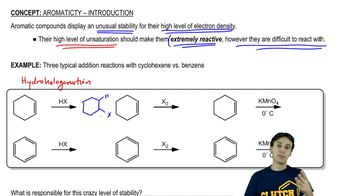
Aromaticity

Aromaticity is a property of cyclic, planar structures with a ring of resonance bonds that leads to enhanced stability. For a molecule to be aromatic, it must follow Hückel's rule, which requires a conjugated system with (4n + 2) π electrons, where n is a non-negative integer. This rule helps determine if a molecule is aromatic, nonaromatic, or antiaromatic.
Video consigliato:
08:19
Intro to Aromaticity

Hückel's Rule

Hückel's rule is a criterion used to determine if a planar ring molecule will have aromatic properties. It states that a molecule is aromatic if it has (4n + 2) π electrons, where n is an integer. This rule is crucial for identifying aromatic compounds, as it explains the stability and electronic configuration of the molecule.
Video consigliato:
03:54
The 18 and 16 Electron Rule

Heterocyclic Compounds

Heterocyclic compounds are cyclic compounds that contain atoms of at least two different elements as members of their ring(s). In the context of aromaticity, the presence of heteroatoms like nitrogen can affect the electron count and the application of Hückel's rule, as these atoms can contribute lone pairs to the π system, influencing the molecule's aromatic character.
Video consigliato:
Percorso guidato
2:06
Nomenclature of Heterocycles Concept 1