
Ch. 23 - Benzene 1: Aromatic Stability and Substitution Reactions
Mullins - Organic Chemistry: A Learner Centered Approach 1st Edition
Mullins1st EditionOrganic Chemistry: A Learner Centered ApproachISBN: 9780137566471Non è quello che usi tu?Cambia libro di testo
Capitolo 22, Problema 61e

(i) Classify the following molecules as aromatic, nonaromatic, or antiaromatic.
(ii) For aromatic molecules, solve for n in Hückel’s rule. For all other molecules, explain which rule of aromaticity is being broken.
(e) Chemical structure of a positively charged aromatic molecule with a hexagonal ring and a double bond.

Guida verificata passo dopo passo
1
Identify the molecule: The structure shown is a cyclopentadienyl cation, which is a five-membered ring with two double bonds and a positive charge.
Determine the number of π electrons: Count the π electrons in the molecule. Each double bond contributes two π electrons, so there are a total of 4 π electrons in the cyclopentadienyl cation.
Apply Hückel's rule: Hückel's rule states that a molecule is aromatic if it has (4n + 2) π electrons, where n is a non-negative integer. Check if 4 π electrons fit this rule.
Evaluate aromaticity: Since 4 π electrons do not satisfy the (4n + 2) rule, the molecule cannot be classified as aromatic. Instead, it fits the 4n rule, which is characteristic of antiaromatic compounds.
Conclude the classification: The cyclopentadienyl cation is antiaromatic because it has 4 π electrons, which fits the 4n rule, leading to instability due to the lack of aromatic stabilization.

Risposta video verificata per un problema simile:

Questa soluzione video è stata consigliata dai nostri tutor come utile per risolvere questo problema.

Concetti chiave

Ecco i concetti essenziali che devi comprendere per rispondere correttamente alla domanda.

Aromaticity

Aromaticity refers to a property of cyclic compounds that exhibit enhanced stability due to the delocalization of π electrons across the ring structure. For a molecule to be classified as aromatic, it must be cyclic, planar, and follow Hückel's rule, which states that it must have a specific number of π electrons (4n + 2, where n is a non-negative integer).
Video consigliato:
08:19
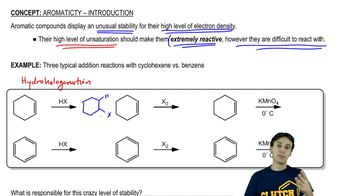
Intro to Aromaticity

Hückel's Rule

Hückel's rule is a criterion used to determine the aromaticity of a compound. It states that a planar, cyclic molecule is aromatic if it contains 4n + 2 π electrons in its conjugated system. This rule helps in identifying aromatic compounds and is essential for solving problems related to their stability and reactivity.
Video consigliato:
03:54
The 18 and 16 Electron Rule

Anti-aromaticity

Anti-aromaticity is a property of cyclic compounds that have 4n π electrons, leading to increased instability compared to non-aromatic compounds. Such molecules do not fulfill Hückel's rule and often exhibit significant strain or reactivity due to their electron configuration. Understanding anti-aromaticity is crucial for classifying molecules correctly in organic chemistry.
Video consigliato:
03:19
The Anti-Coplanar Requirement
Pratica correlata
Domanda del libro di testo

(i) Classify the following molecules as aromatic, nonaromatic, or antiaromatic.

(ii) For aromatic molecules, solve for n in Hückel’s rule. For all other molecules, explain which rule of aromaticity is being broken.

(d)

421
views
Domanda del libro di testo

(i) Classify the following molecules as aromatic, nonaromatic, or antiaromatic.

(ii) For aromatic molecules, solve for n in Hückel’s rule. For all other molecules, explain which rule of aromaticity is being broken.

(h)

444
views
Domanda del libro di testo

(i) Classify the following molecules as aromatic, nonaromatic, or antiaromatic.

(ii) For aromatic molecules, solve for n in Hückel’s rule. For all other molecules, explain which rule of aromaticity is being broken.

(g)

451
views
Domanda del libro di testo

(i) Classify the following molecules as aromatic, nonaromatic, or antiaromatic.

(ii) For aromatic molecules, solve for n in Hückel’s rule. For all other molecules, explain which rule of aromaticity is being broken.

(c)

339
views
Domanda del libro di testo

(i) Classify the following molecules as aromatic, nonaromatic, or antiaromatic.

(ii) For aromatic molecules, solve for n in Hückel’s rule. For all other molecules, explain which rule of aromaticity is being broken.

(b)

540
views
Domanda del libro di testo

(i) Classify the following molecules as aromatic, nonaromatic, or antiaromatic.

(ii) For aromatic molecules, solve for n in Hückel’s rule. For all other molecules, explain which rule of aromaticity is being broken.

(f)

489
views