Ch. 23 - Benzene 1: Aromatic Stability and Substitution Reactions
Mullins - Organic Chemistry: A Learner Centered Approach 1st Edition
Mullins1st EditionOrganic Chemistry: A Learner Centered ApproachISBN: 9780137566471Non è quello che usi tu?Cambia libro di testo
Capitolo 22, Problema 33b

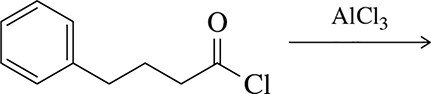
Predict the product of the following Friedel–Crafts acylation reactions.
(b) Chemical structure depicting a Friedel-Crafts acylation reaction with a benzene ring, acyl chloride, and aluminum chloride.

Guida verificata passo dopo passo
1
Identify the acyl chloride in the reaction. In this case, it is a 4-chlorobutanoyl chloride, which will be used in the Friedel-Crafts acylation.
Recognize the role of AlCl₃ as a Lewis acid catalyst. It will facilitate the generation of the acylium ion from the acyl chloride.
Understand that the acylium ion, which is a positively charged species, will be formed by the interaction of the acyl chloride with AlCl₃. This ion is highly electrophilic and will attack the benzene ring.
Predict the site of electrophilic attack on the benzene ring. The acylium ion will preferentially attack the para position relative to any existing substituents, unless steric hindrance or other directing effects are present.
Consider the final product structure. The acyl group will be added to the benzene ring, resulting in a ketone with the acyl group attached to the para position of the benzene ring.

Risposta video verificata per un problema simile:

Questa soluzione video è stata consigliata dai nostri tutor come utile per risolvere questo problema.

Concetti chiave

Ecco i concetti essenziali che devi comprendere per rispondere correttamente alla domanda.

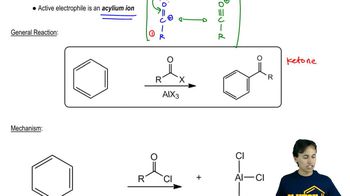
Friedel-Crafts Acylation

Friedel-Crafts acylation is a reaction that introduces an acyl group into an aromatic ring using an acyl chloride and a Lewis acid catalyst, typically aluminum chloride (AlCl3). The reaction proceeds through the formation of an acylium ion, which acts as an electrophile, attacking the electron-rich aromatic ring to form a ketone. This reaction is useful for adding carbonyl groups to aromatic compounds, enhancing their reactivity and functional diversity.
Video consigliato:
05:20
Friedel-Crafts Acylation

Role of Aluminum Chloride (AlCl3)

Aluminum chloride (AlCl3) is a strong Lewis acid used as a catalyst in Friedel-Crafts reactions. It facilitates the generation of the acylium ion from the acyl chloride by accepting a chloride ion, thus increasing the electrophilicity of the acyl group. This enhanced electrophile can then effectively attack the aromatic ring, leading to the substitution of a hydrogen atom with the acyl group, forming a ketone.
Video consigliato:
03:13
Acid Chloride Nomenclature

Electrophilic Aromatic Substitution

Electrophilic aromatic substitution (EAS) is a fundamental reaction mechanism in organic chemistry where an electrophile replaces a hydrogen atom on an aromatic ring. In the context of Friedel-Crafts acylation, the acylium ion acts as the electrophile, attacking the π-electron-rich benzene ring. The reaction proceeds through the formation of a resonance-stabilized carbocation intermediate, followed by deprotonation to restore aromaticity, resulting in the acylated aromatic compound.
Video consigliato:
03:07
EAS Review