Ch. 23 - Benzene 1: Aromatic Stability and Substitution Reactions
Mullins - Organic Chemistry: A Learner Centered Approach 1st Edition
Mullins1st EditionOrganic Chemistry: A Learner Centered ApproachISBN: 9780137566471Non è quello che usi tu?Cambia libro di testo
Capitolo 22, Problema 63

Using a Frost circle, a student drew the molecular orbital picture shown for the cyclopentadienyl anion, determining it to be antiaromatic. Do you agree with this conclusion? Why or why not?
Molecular orbital diagram of the cyclopentadienyl anion, illustrating antiaromatic characteristics.

Guida verificata passo dopo passo
1
Identify the structure in question: The cyclopentadienyl anion is a five-membered ring with a negative charge, which means it has 6 π electrons (4 from the double bonds and 2 from the negative charge).
Apply Hückel's rule for aromaticity: A molecule is aromatic if it is cyclic, planar, fully conjugated, and has 4n+2 π electrons, where n is a non-negative integer.
Determine the number of π electrons: The cyclopentadienyl anion has 6 π electrons, which fits the 4n+2 rule (n=1, since 4(1)+2=6).
Analyze the Frost circle diagram: The Frost circle for a five-membered ring should have one molecular orbital at the bottom, two degenerate orbitals in the middle, and two degenerate orbitals at the top. The diagram shows that all 6 π electrons fill the bonding orbitals, which is consistent with aromaticity.
Conclude based on the analysis: Since the cyclopentadienyl anion satisfies all the criteria for aromaticity, including the 4n+2 rule, it is aromatic, not antiaromatic. Therefore, the student's conclusion is incorrect.

Risposta video verificata per un problema simile:

Questa soluzione video è stata consigliata dai nostri tutor come utile per risolvere questo problema.
Durata del video:
2m

Concetti chiave

Ecco i concetti essenziali che devi comprendere per rispondere correttamente alla domanda.

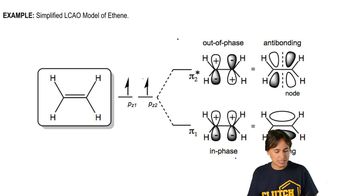
Molecular Orbitals

Molecular orbitals (MOs) are formed by the combination of atomic orbitals when atoms bond together. In the context of cyclopentadienyl anion, understanding how the p orbitals overlap to create bonding and antibonding MOs is crucial. The arrangement and energy levels of these orbitals determine the stability and reactivity of the molecule.
Video consigliato:
08:41
Review of Molecular Orbitals

Aromaticity and Antiaromaticity

Aromatic compounds are cyclic, planar molecules with a continuous overlap of p orbitals, allowing for delocalized π electrons that follow Hückel's rule (4n + 2 π electrons). In contrast, antiaromatic compounds have 4n π electrons, leading to destabilization. Recognizing these criteria is essential for evaluating the cyclopentadienyl anion's classification.
Video consigliato:
02:58
Determine the aromaticity

Frost Circle

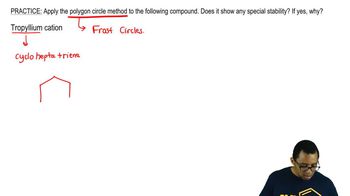
The Frost circle is a graphical method used to determine the molecular orbitals of cyclic compounds. By inscribing the polygon corresponding to the number of carbon atoms in a circle and marking the points where the vertices touch the circle, one can visualize the energy levels of the MOs. This tool is particularly useful for assessing the aromatic or antiaromatic nature of cyclic systems like the cyclopentadienyl anion.
Video consigliato:
02:56
Inscribed Polygon Method