

Ch. 23 - Benzene 1: Aromatic Stability and Substitution Reactions
Mullins - Organic Chemistry: A Learner Centered Approach 1st Edition
Mullins1st EditionOrganic Chemistry: A Learner Centered ApproachISBN: 9780137566471Non è quello che usi tu?Cambia libro di testo
Capitolo 22, Problema 62a

Use a Frost circle diagram to construct the molecular orbital diagram for the molecules shown. Would you expect them to be aromatic or antiaromatic?
(a) Frost circle diagram illustrating molecular orbital construction for evaluating aromaticity.

Guida verificata passo dopo passo
1
Identify the molecule: The image shows a square with two double bonds, which is cyclobutadiene.
Draw the Frost circle: Place the polygon (square) inside a circle with one vertex pointing down. The vertices of the polygon represent the energy levels of the molecular orbitals.
Determine the number of π electrons: Cyclobutadiene has 4 π electrons, as each double bond contributes 2 π electrons.
Fill the molecular orbitals: Start filling the molecular orbitals from the lowest energy level upwards, following Hund's rule and the Pauli exclusion principle.
Assess aromaticity: Apply Hückel's rule, which states that a molecule is aromatic if it has (4n + 2) π electrons. Cyclobutadiene has 4 π electrons, which fits the 4n rule, indicating it is antiaromatic.

Risposta video verificata per un problema simile:

Questa soluzione video è stata consigliata dai nostri tutor come utile per risolvere questo problema.

Concetti chiave

Ecco i concetti essenziali che devi comprendere per rispondere correttamente alla domanda.

Frost Circle Diagram

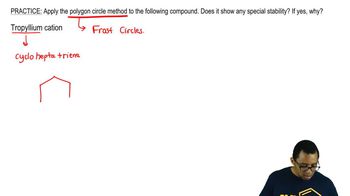
A Frost circle diagram is a tool used to construct molecular orbital diagrams for cyclic conjugated systems. It involves inscribing a polygon representing the molecule inside a circle, with vertices touching the circle. The energy levels of the molecular orbitals are determined by the positions of these vertices, helping to predict the stability and aromaticity of the molecule.
Video consigliato:
02:56
Inscribed Polygon Method

Aromaticity

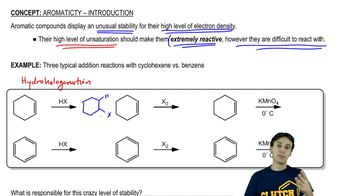
Aromaticity is a property of cyclic, planar molecules with a ring of resonance bonds that leads to enhanced stability. According to Hückel's rule, a molecule is aromatic if it has (4n + 2) π electrons, where n is a non-negative integer. Aromatic compounds are typically more stable than their non-aromatic counterparts due to delocalized electrons.
Video consigliato:
08:19
Intro to Aromaticity

Antiaromaticity

Antiaromaticity refers to the instability in cyclic, planar molecules with a conjugated π electron system that follows the (4n) π electron rule. Unlike aromatic compounds, antiaromatic compounds are less stable due to the lack of electron delocalization, leading to increased reactivity. Understanding antiaromaticity is crucial for predicting the behavior of certain organic molecules.
Video consigliato:
02:58
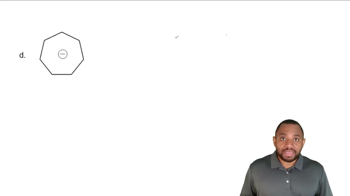
Determine the aromaticity