Ch. 23 - Benzene 1: Aromatic Stability and Substitution Reactions
Mullins - Organic Chemistry: A Learner Centered Approach 1st Edition
Mullins1st EditionOrganic Chemistry: A Learner Centered ApproachISBN: 9780137566471Non è quello che usi tu?Cambia libro di testo
Capitolo 22, Problema 39

With a small electron-donating group on the ring, it is possible to get as much as a 2:1 ratio of ortho to para. Why might this be?

Guida verificata passo dopo passo
1
Identify the electron-donating group on the benzene ring. In this case, the methyl group (CH₃) is the electron-donating group.
Understand that electron-donating groups activate the benzene ring towards electrophilic aromatic substitution, making the ortho and para positions more reactive.
Recognize that the ortho position is sterically hindered compared to the para position, but the methyl group is small, reducing steric hindrance and allowing for significant ortho substitution.
Consider the resonance effect: the electron-donating group increases electron density at the ortho and para positions, stabilizing the carbocation intermediate formed during the reaction.
Conclude that the combination of electronic effects (activation and resonance stabilization) and reduced steric hindrance leads to a higher ratio of ortho to para substitution, resulting in the observed 2:1 ratio.

Risposta video verificata per un problema simile:

Questa soluzione video è stata consigliata dai nostri tutor come utile per risolvere questo problema.

Concetti chiave

Ecco i concetti essenziali che devi comprendere per rispondere correttamente alla domanda.

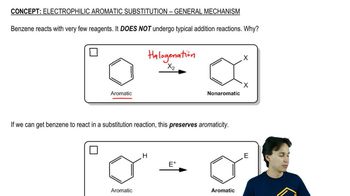
Electrophilic Aromatic Substitution (EAS)

Electrophilic Aromatic Substitution is a reaction where an electrophile replaces a hydrogen atom on an aromatic ring. In the presence of a catalyst like FeCl3, chlorine acts as the electrophile, attacking the benzene ring. The position of substitution is influenced by existing substituents on the ring, which can direct the incoming group to ortho, meta, or para positions.
Video consigliato:
03:07
EAS Review

Ortho/Para Directing Groups

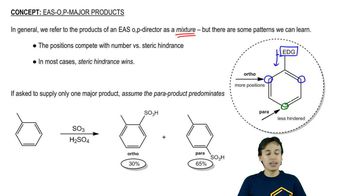
Ortho/para directing groups are substituents on an aromatic ring that increase the electron density at the ortho and para positions, making them more reactive to electrophilic attack. Electron-donating groups, such as alkyl groups, stabilize the carbocation intermediate formed during EAS, favoring substitution at these positions. This explains the higher ratio of ortho to para products in the presence of such groups.
Video consigliato:
04:42
Ortho, Para major products

Steric and Electronic Effects

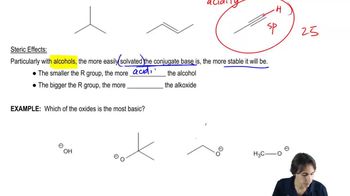
Steric and electronic effects influence the distribution of substitution products in EAS. Small electron-donating groups, like methyl, enhance electron density at ortho and para positions, but steric hindrance is less at the para position. However, the ortho position can still be favored due to proximity effects and resonance stabilization, leading to a 2:1 ortho to para product ratio.
Video consigliato:
02:53
Understanding steric effects.