Ch. 25 - Amines: Structure, Reactions, and Synthesis
Mullins - Organic Chemistry: A Learner Centered Approach 1st Edition
Mullins1st EditionOrganic Chemistry: A Learner Centered ApproachISBN: 9780137566471Non è quello che usi tu?Cambia libro di testo
Capitolo 24, Problema 46b

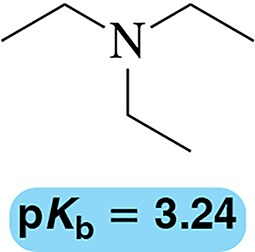
Given the pKb, calculate the pKa of the conjugate acid.
(b)

Guida verificata passo dopo passo
1
Understand the relationship between pKa and pKb. The pKa of a conjugate acid and the pKb of its conjugate base are related by the equation: pKa + pKb = 14 (at 25°C). This is derived from the ionization constant of water, Kw, where Kw = 10-14.
Rearrange the equation to solve for pKa: pKa = 14 - pKb.
Substitute the given value of pKb into the equation. For example, if pKb = 4.75, substitute it into the equation: pKa = 14 - 4.75.
Perform the subtraction to determine the pKa value. This step involves simple arithmetic, but ensure you understand the concept of how pKa and pKb are inversely related.
Interpret the result. A lower pKa value indicates a stronger conjugate acid, while a higher pKa value indicates a weaker conjugate acid. This relationship is important in understanding acid-base chemistry.

Risposta video verificata per un problema simile:

Questa soluzione video è stata consigliata dai nostri tutor come utile per risolvere questo problema.
Durata del video:
2m

Concetti chiave

Ecco i concetti essenziali che devi comprendere per rispondere correttamente alla domanda.

pKb and pKa Definitions

pKb is the negative logarithm of the base dissociation constant (Kb) of a weak base, indicating its strength. Conversely, pKa is the negative logarithm of the acid dissociation constant (Ka) of a weak acid. The relationship between pKa and pKb is crucial for understanding acid-base equilibria, as they are related through the equation: pKa + pKb = 14 at 25°C.
Video consigliato:
07:45
Identifying pKa values

Conjugate Acid-Base Pairs

In acid-base chemistry, a conjugate acid is formed when a base accepts a proton (H+). Each acid has a corresponding conjugate base, which is what remains after the acid donates a proton. Understanding these pairs is essential for calculating pKa from pKb, as it allows for the identification of the acid's strength based on its conjugate base's properties.
Video consigliato:
Percorso guidato
2:56
Base Pairing Concept 1

Calculating pKa from pKb

To calculate the pKa of a conjugate acid from its pKb, one can use the formula: pKa = 14 - pKb. This equation reflects the inverse relationship between the strength of a base and its conjugate acid. By knowing the pKb value, one can easily determine the pKa, which is vital for predicting the behavior of acids and bases in various chemical reactions.
Video consigliato:
07:45
Identifying pKa values