Ch. 25 - Amines: Structure, Reactions, and Synthesis
Mullins - Organic Chemistry: A Learner Centered Approach 1st Edition
Mullins1st EditionOrganic Chemistry: A Learner Centered ApproachISBN: 9780137566471Non è quello che usi tu?Cambia libro di testo
Capitolo 24, Problema 47b

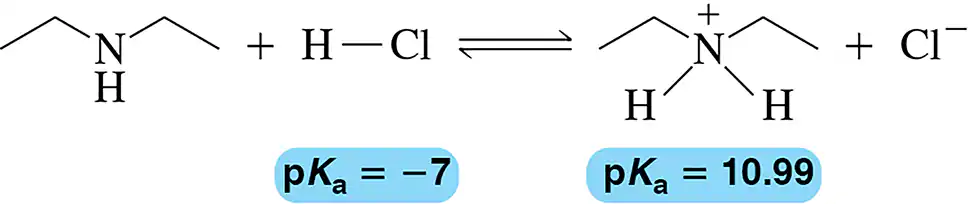
Calculate the equilibrium constant for each of the acid–base reactions shown.
b. Chemical reaction diagram showing an acid-base reaction with pKa values of -7 and 10.99 for the reactants and products.

Guida verificata passo dopo passo
1
Identify the acid and base on both sides of the reaction. Determine which species is donating a proton (acid) and which is accepting a proton (base).
Write the equilibrium constant expression for the acid-base reaction. The equilibrium constant (K_eq) is given by the formula: Keq = Kaacid1Kaacid2, where Ka values correspond to the acids on each side of the reaction.
Look up the pKa values for the acids on both sides of the reaction. Recall that Ka = 10-pKa, so you can calculate the Ka values if needed.
Substitute the Ka values into the equilibrium constant expression. Ensure that the acid on the reactant side is in the numerator and the acid on the product side is in the denominator.
Simplify the expression to determine the equilibrium constant (K_eq). This will indicate whether the reaction favors the reactants or the products.

Risposta video verificata per un problema simile:

Questa soluzione video è stata consigliata dai nostri tutor come utile per risolvere questo problema.
Durata del video:
2m

Concetti chiave

Ecco i concetti essenziali che devi comprendere per rispondere correttamente alla domanda.

Acid-Base Reactions

Acid-base reactions involve the transfer of protons (H+) between reactants. An acid is a substance that donates protons, while a base accepts them. Understanding the nature of the acids and bases involved is crucial for predicting the direction of the reaction and calculating the equilibrium constant.
Video consigliato:
02:49
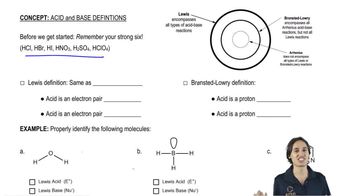
The Lewis definition of acids and bases.

Equilibrium Constant (K)

The equilibrium constant (K) quantifies the ratio of the concentrations of products to reactants at equilibrium for a given reaction at a specific temperature. For acid-base reactions, K can be expressed in terms of the concentrations of the conjugate acids and bases. A larger K value indicates a reaction that favors product formation.
Video consigliato:
02:19
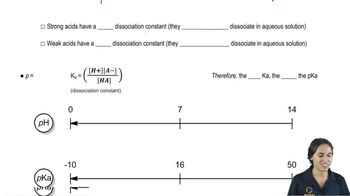
The relationship between equilibrium constant and pKa.

Conjugate Acid-Base Pairs

Conjugate acid-base pairs consist of an acid and its corresponding base that differ by a single proton. When an acid donates a proton, it forms its conjugate base, and vice versa. Recognizing these pairs is essential for calculating equilibrium constants and understanding the dynamics of acid-base reactions.
Video consigliato:
Percorso guidato
2:56
Base Pairing Concept 1