Ch. 25 - Amines: Structure, Reactions, and Synthesis
Mullins - Organic Chemistry: A Learner Centered Approach 1st Edition
Mullins1st EditionOrganic Chemistry: A Learner Centered ApproachISBN: 9780137566471Non è quello che usi tu?Cambia libro di testo
Capitolo 24, Problema 56b

Suggest reagents to carry out the following transformations. Some may require more than one step.
(b) Chemical reaction: Bromopyridine transforms to N-methylpyridylamine, indicating a Buchwald-Hartwig amination process.

Guida verificata passo dopo passo
1
Identify the starting material and the product. The starting material is 2-bromo-3-methylpyridine, and the product is 2-dimethylamino-3-methylpyridine.
Recognize that the transformation involves replacing the bromine atom with a dimethylamino group. This suggests a nucleophilic substitution reaction.
Consider using a nucleophilic substitution reaction such as the Buchwald-Hartwig amination, which is effective for aryl halides. This reaction typically requires a palladium catalyst, a ligand, and a base.
Select appropriate reagents for the Buchwald-Hartwig amination. A common choice is Pd(OAc)₂ as the catalyst, a phosphine ligand like Xantphos, and a base such as sodium tert-butoxide.
Use dimethylamine as the nucleophile in the reaction. The reaction conditions should facilitate the substitution of the bromine atom with the dimethylamino group, yielding the desired product.

Risposta video verificata per un problema simile:

Questa soluzione video è stata consigliata dai nostri tutor come utile per risolvere questo problema.
Durata del video:
1m

Concetti chiave

Ecco i concetti essenziali che devi comprendere per rispondere correttamente alla domanda.

Nucleophilic Aromatic Substitution

Nucleophilic aromatic substitution involves the replacement of a leaving group, such as bromine, on an aromatic ring with a nucleophile. This reaction is facilitated by electron-withdrawing groups on the ring, which stabilize the intermediate. In this transformation, the bromine is replaced by an amine group, indicating a nucleophilic substitution process.
Video consigliato:
01:47
Nucleophiles and Electrophiles can react in Substitution Reactions.

Amination

Amination is the process of introducing an amine group into a molecule. In this reaction, the brominated aniline undergoes amination to form a substituted aniline. This typically involves the use of reagents like ammonia or amines, often under conditions that promote nucleophilic attack on the aromatic ring.
Video consigliato:
07:12
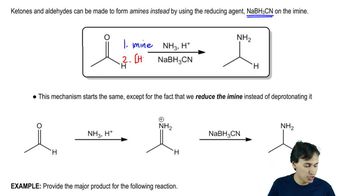
Reductive Amination

Pyridine Ring Chemistry

Pyridine is a basic heterocyclic aromatic organic compound with a nitrogen atom. Its chemistry is influenced by the electron-withdrawing nature of the nitrogen, which affects reactivity and substitution patterns. Understanding pyridine's behavior is crucial for predicting outcomes in reactions involving pyridine derivatives, such as the transformation shown in the image.
Video consigliato:
Percorso guidato
1:07
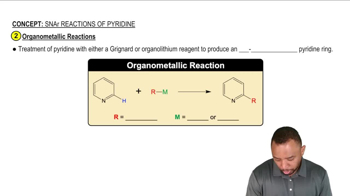
SNAr Reactions of Pyridine Concept 2