Ch. 25 - Amines: Structure, Reactions, and Synthesis
Mullins - Organic Chemistry: A Learner Centered Approach 1st Edition
Mullins1st EditionOrganic Chemistry: A Learner Centered ApproachISBN: 9780137566471Non è quello che usi tu?Cambia libro di testo
Capitolo 24, Problema 55b

Predict the product(s) of the reactions shown.
(b)

Guida verificata passo dopo passo
1
Identify the starting material: The compound is an aromatic amine, specifically an aniline derivative with a tert-butyl group attached to the benzene ring.
Understand the reaction conditions: The first step involves NaNO2 and HCl, which is used to convert the amine group into a diazonium salt. This is known as diazotization.
Write the diazotization reaction: The amine group (NH2) will be transformed into a diazonium group (N2+), forming an aryl diazonium salt. The reaction can be represented as: NH2 + NaNO2 + HCl → N2+ + Cl- + H2O.
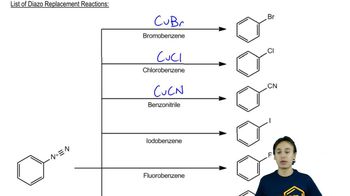
Consider the second step: The diazonium salt reacts with CuCl, which is a Sandmeyer reaction. This reaction replaces the diazonium group with a chlorine atom.
Predict the final product: The tert-butyl group remains unchanged, and the diazonium group is replaced by a chlorine atom, resulting in a chlorinated aromatic compound.

Risposta video verificata per un problema simile:

Questa soluzione video è stata consigliata dai nostri tutor come utile per risolvere questo problema.
Durata del video:
1m

Concetti chiave

Ecco i concetti essenziali che devi comprendere per rispondere correttamente alla domanda.

Diazotization Reaction

Diazotization is a chemical reaction that converts an aromatic amine into a diazonium salt using nitrous acid, typically generated in situ from sodium nitrite and hydrochloric acid. This reaction is crucial for introducing a diazonium group, which can be further transformed into various functional groups through substitution reactions.
Video consigliato:
06:59
Replacement Reactions

Sandmeyer Reaction

The Sandmeyer reaction involves the substitution of an aromatic diazonium group with a halide or pseudohalide using copper(I) salts. In this case, CuCl facilitates the replacement of the diazonium group with a chlorine atom, allowing for the synthesis of aryl chlorides from aryl amines, expanding the functional diversity of aromatic compounds.
Video consigliato:
05:09
Heck Reaction

Aromatic Substitution

Aromatic substitution refers to the replacement of a substituent on an aromatic ring with another group. In the context of the reaction shown, the diazonium group formed from the amine is substituted by a chlorine atom, demonstrating the versatility of aromatic compounds in undergoing various substitution reactions to yield different products.
Video consigliato:
08:19
Intro to Aromaticity