
Ch. 27 - Carbohydrates, Nucleic Acids, and Lipids
Mullins - Organic Chemistry: A Learner Centered Approach 1st Edition
Mullins1st EditionOrganic Chemistry: A Learner Centered ApproachISBN: 9780137566471Non è quello che usi tu?Cambia libro di testo
Capitolo 26, Problema 77

Is the compound d or l?

Guida verificata passo dopo passo
1
Step 1: Understand the concept of optical isomerism. Optical isomers, also known as enantiomers, are molecules that are mirror images of each other and cannot be superimposed. They are designated as 'd' (dextrorotatory) or 'l' (levorotatory) based on the direction they rotate plane-polarized light.
Step 2: Identify the chiral center in the compound. A chiral center is typically a carbon atom bonded to four different groups. This is crucial for determining the optical activity of the compound.
Step 3: Assign priorities to the substituents attached to the chiral center using the Cahn-Ingold-Prelog priority rules. The substituent with the highest atomic number gets the highest priority.
Step 4: Determine the configuration of the chiral center. Arrange the molecule so that the lowest priority group is pointing away from you. Then, observe the order of the remaining groups. If the sequence is clockwise, the configuration is 'R'; if counterclockwise, it is 'S'.
Step 5: Relate the configuration to optical activity. While 'R' and 'S' configurations do not directly indicate 'd' or 'l', experimental determination of optical rotation is required. If the compound rotates light to the right, it is 'd'; if to the left, it is 'l'.

Risposta video verificata per un problema simile:

Questa soluzione video è stata consigliata dai nostri tutor come utile per risolvere questo problema.
Durata del video:
1m

Concetti chiave

Ecco i concetti essenziali che devi comprendere per rispondere correttamente alla domanda.

Chirality

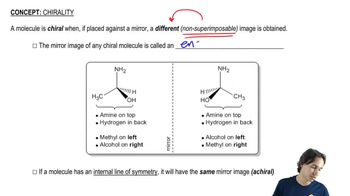
Chirality refers to the geometric property of a molecule having a non-superimposable mirror image, much like left and right hands. In organic chemistry, chiral molecules typically have a carbon atom bonded to four different groups, creating two enantiomers that are mirror images of each other. Understanding chirality is essential for determining the optical activity of compounds.
Video consigliato:
05:10
What is chirality?

Fischer Projection

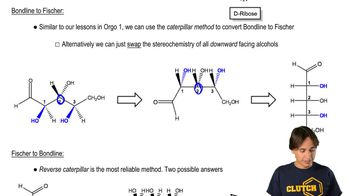
The Fischer projection is a two-dimensional representation of a three-dimensional organic molecule used to depict stereochemistry. It is particularly useful for carbohydrates and amino acids, where horizontal lines represent bonds coming out of the plane, and vertical lines represent bonds going into the plane. This projection helps in identifying the configuration of chiral centers as D or L.
Video consigliato:
09:56
Monosaccharides - Drawing Fischer Projections

D and L Configuration

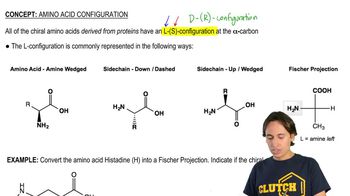
The D and L configuration system is used to denote the absolute configuration of chiral molecules, particularly sugars and amino acids. It is based on the orientation of the hydroxyl group on the chiral carbon farthest from the carbonyl group in Fischer projections. If the hydroxyl group is on the right, the molecule is D; if on the left, it is L. This system is crucial for understanding the stereochemistry of biomolecules.
Video consigliato:
05:09
Representations of L-Configuration