
Ch. 27 - Carbohydrates, Nucleic Acids, and Lipids
Mullins - Organic Chemistry: A Learner Centered Approach 1st Edition
Mullins1st EditionOrganic Chemistry: A Learner Centered ApproachISBN: 9780137566471Non è quello che usi tu?Cambia libro di testo
Capitolo 26, Problema 90

α-Pinene is a terpene found in pine trees. Starting from geranyl diphosphate (a terpene), draw the arrow-pushing mechanism to produce α-pinene. Assume that an enzyme active site will provide whatever acids and bases you might need.

Guida verificata passo dopo passo
1
Identify the starting material, geranyl diphosphate, which contains a diphosphate group attached to a 10-carbon terpene backbone. The diphosphate group is a good leaving group, making this molecule primed for a reaction.
Recognize that the reaction involves the formation of α-pinene, a bicyclic terpene. This suggests that the mechanism will involve cyclization and rearrangement steps.
The first step is the ionization of the diphosphate group. The enzyme active site provides an acidic environment to protonate the diphosphate group, facilitating its departure and generating a carbocation at the allylic position.
The carbocation undergoes a cyclization reaction. The double bond in the terpene backbone attacks the carbocation, forming a six-membered ring intermediate. This step involves arrow-pushing to show the movement of electrons from the double bond to the carbocation.
A second cyclization occurs to form the bicyclic structure of α-pinene. The remaining double bond attacks the newly formed carbocation, creating the bicyclic framework. Finally, deprotonation by a base in the enzyme active site stabilizes the structure, yielding α-pinene.

Risposta video verificata per un problema simile:

Questa soluzione video è stata consigliata dai nostri tutor come utile per risolvere questo problema.
Durata del video:
7m

Concetti chiave

Ecco i concetti essenziali che devi comprendere per rispondere correttamente alla domanda.

Terpenes and Their Biosynthesis

Terpenes are a large and diverse class of organic compounds produced by various plants, particularly conifers. They are synthesized from isoprene units, and their biosynthesis often involves the conversion of geranyl diphosphate (GPP) into more complex structures. Understanding the basic structure and function of terpenes is essential for grasping how α-pinene is formed from GPP.
Video consigliato:
Percorso guidato
3:13
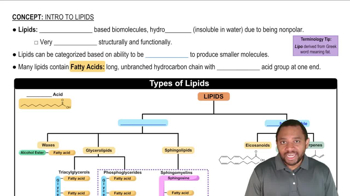
Intro to Lipids Concept 1

Arrow-Pushing Mechanism

The arrow-pushing mechanism is a method used in organic chemistry to illustrate the movement of electrons during chemical reactions. It involves using arrows to show the flow of electron pairs, indicating bond formation and breaking. This technique is crucial for visualizing the steps involved in the conversion of geranyl diphosphate to α-pinene, including any intermediates and transition states.
Video consigliato:
04:32
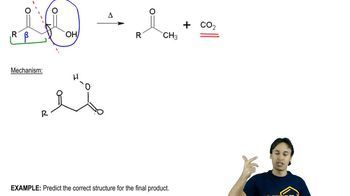
General Mechanism

Enzyme Catalysis

Enzymes are biological catalysts that speed up chemical reactions by lowering the activation energy required for the reaction to proceed. In the context of terpene biosynthesis, enzymes facilitate the conversion of substrates like geranyl diphosphate into products such as α-pinene. Understanding enzyme mechanisms, including the role of acids and bases in the active site, is vital for accurately depicting the reaction pathway.
Video consigliato:
Percorso guidato
2:31
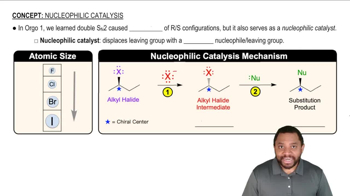
Nucleophilic Catalysis Concept 1