Ch. 3 - Alkanes and Cycloalkanes: Properties and Conformational Analysis
Mullins - Organic Chemistry: A Learner Centered Approach 1st Edition
Mullins1st EditionOrganic Chemistry: A Learner Centered ApproachISBN: 9780137566471Non è quello che usi tu?Cambia libro di testo
Capitolo 2, Problema 39a

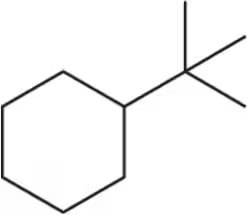
Draw two chair conformations of the molecules below. Indicate which is most stable.
(a) Two chair conformations of a cyclohexane derivative, illustrating equatorial and axial positions for stability comparison.

Guida verificata passo dopo passo
1
Identify the molecule's structure and determine the substituents attached to the cyclohexane ring. Note the positions (axial or equatorial) of each substituent in the chair conformation.
Draw the first chair conformation of the cyclohexane ring. Place the substituents in their respective positions (axial or equatorial) based on the given structure.
Draw the second chair conformation by performing a ring flip. In a ring flip, all axial substituents become equatorial, and all equatorial substituents become axial.
Analyze the stability of each chair conformation. Stability is influenced by steric hindrance and 1,3-diaxial interactions. Substituents in the equatorial position generally result in a more stable conformation due to reduced steric strain.
Compare the two chair conformations and determine which one is more stable. Indicate the most stable conformation based on the positions of the substituents and their interactions.

Risposta video verificata per un problema simile:

Questa soluzione video è stata consigliata dai nostri tutor come utile per risolvere questo problema.
Durata del video:
2m

Concetti chiave

Ecco i concetti essenziali che devi comprendere per rispondere correttamente alla domanda.

Chair Conformation

The chair conformation is a three-dimensional representation of cyclohexane that minimizes steric strain and torsional strain. In this conformation, the carbon atoms are arranged in a staggered manner, allowing for more stable interactions between substituents. Understanding chair conformations is crucial for predicting the stability of cyclohexane derivatives and their substituents.
Video consigliato:
03:29
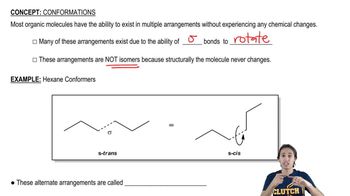
Understanding what a conformer is.

Stability Factors

The stability of chair conformations is influenced by factors such as steric hindrance and torsional strain. Steric hindrance occurs when bulky groups are positioned close to each other, leading to increased repulsion. Additionally, the orientation of substituents (axial vs. equatorial) affects stability, with equatorial positions generally being more favorable due to reduced steric interactions.
Video consigliato:
03:43
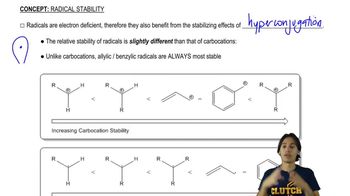
The radical stability trend.

Axial and Equatorial Positions

In chair conformations, substituents can occupy axial or equatorial positions. Axial substituents are aligned parallel to the axis of the ring, while equatorial substituents extend outward from the ring. The preference for equatorial positions arises because they minimize steric clashes with other axial substituents, making the overall conformation more stable.
Video consigliato:
04:02
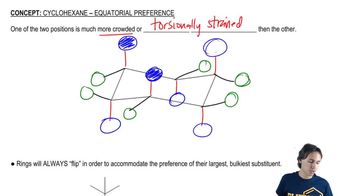
Equatorial Preference