Ch. 3 - Alkanes and Cycloalkanes: Properties and Conformational Analysis
Mullins - Organic Chemistry: A Learner Centered Approach 1st Edition
Mullins1st EditionOrganic Chemistry: A Learner Centered ApproachISBN: 9780137566471Non è quello che usi tu?Cambia libro di testo
Capitolo 2, Problema 59g

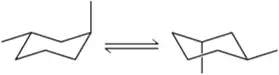
For each pair of conformations shown, choose which is most stable. If both are equally stable, then write 'no difference.' [If both conformations have the same number of axial substituents, choose the one with the smallest axial substituents.]
(g) Two conformations of a cycloalkane are shown, indicating a comparison of their stability.

Guida verificata passo dopo passo
1
Step 1: Understand the concept of chair conformations in cyclohexane. Cyclohexane can adopt two chair conformations, and substituents on the ring can occupy either axial (vertical) or equatorial (horizontal) positions. Equatorial positions are generally more stable due to reduced steric hindrance.
Step 2: Analyze the substituents in each conformation. Count the number of axial substituents in both conformations. Axial substituents experience steric interactions with other axial groups on the same side of the ring, which can destabilize the molecule.
Step 3: Compare the size of the axial substituents in both conformations. If both conformations have the same number of axial substituents, the conformation with smaller axial substituents will be more stable due to reduced steric hindrance.
Step 4: If one conformation has fewer axial substituents than the other, it will be the more stable conformation. This is because fewer axial substituents result in less steric strain.
Step 5: If both conformations have the same number of axial substituents and the substituents are of equal size, then there is no difference in stability between the two conformations.

Risposta video verificata per un problema simile:

Questa soluzione video è stata consigliata dai nostri tutor come utile per risolvere questo problema.
Durata del video:
3m

Concetti chiave

Ecco i concetti essenziali che devi comprendere per rispondere correttamente alla domanda.

Conformational Analysis

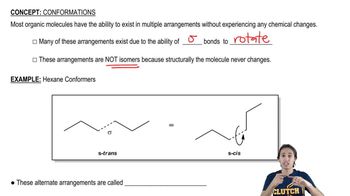
Conformational analysis involves studying the different spatial arrangements of a molecule that can be interconverted by rotation around single bonds. In organic chemistry, this is crucial for understanding the stability of different conformers, as certain arrangements can lead to steric strain or torsional strain, affecting the overall energy and stability of the molecule.
Video consigliato:
03:29
Understanding what a conformer is.

Axial and Equatorial Positions

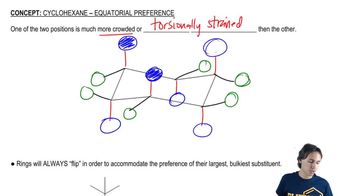
In cyclohexane and similar cyclic structures, substituents can occupy axial (pointing up or down) or equatorial (pointing outward) positions. Axial substituents can lead to 1,3-diaxial interactions, which increase steric hindrance and destabilize the conformation. Therefore, equatorial positions are generally more stable for larger substituents.
Video consigliato:
04:02
Equatorial Preference

Steric Hindrance

Steric hindrance refers to the repulsion between atoms that occurs when they are brought close together, often due to the size of substituents. In conformational analysis, steric hindrance plays a significant role in determining the stability of different conformations, as bulky groups prefer to be in positions that minimize these interactions, typically the equatorial position in cyclohexane.
Video consigliato:
02:53
Understanding steric effects.
Pratica correlata
Domanda del libro di testo

Calculate the energy difference between each pair of conformations shown by drawing and comparing Newman projections down the indicated bonds in each.

(b)

1229
views

Domanda del libro di testo

What is the mistake that was made in drawing each of the flipped chairs on the right from the chair on the left? [In these, assume that the angle through which you view the chair conformations doesn't change.]

(a)

1123
views
Domanda del libro di testo

For each pair of conformations shown, choose which is most stable. If both are equally stable, then write 'no difference.' [If both conformations have the same number of axial substituents, choose the one with the smallest axial substituents.]

(e)

1001
views
Domanda del libro di testo

For each chair on the left, place the substituents on the flipped chair. [Recall that the axial/equatorial designation changes from one chair to the next, but the carbon to which the substituent is attached does not.]

(f)

953
views
Domanda del libro di testo

For each structure shown, draw the two chair conformations and choose which is most stable. Be sure that your second chair is the flipped version of the first. [Make sure that wedged substituents are up in the chair, regardless of whether up is equatorial or axial.]

(g)

1247
views
Domanda del libro di testo

For each structure shown, draw the two chair conformations and choose which is most stable. Be sure that your second chair is the flipped version of the first. [Make sure that wedged substituents are up in the chair, regardless of whether up is equatorial or axial.]

(e)

1557
views