
Ch. 3 - Alkanes and Cycloalkanes: Properties and Conformational Analysis
Mullins - Organic Chemistry: A Learner Centered Approach 1st Edition
Mullins1st EditionOrganic Chemistry: A Learner Centered ApproachISBN: 9780137566471Non è quello che usi tu?Cambia libro di testo
Capitolo 2, Problema 61b

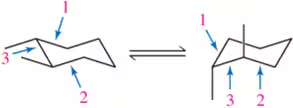
Calculate the energy difference between each pair of conformations shown by drawing and comparing Newman projections down the indicated bonds in each.
(b) Two chair conformations of a cycloalkane with numbered bonds indicating positions for energy comparison.

Guida verificata passo dopo passo
1
Step 1: Begin by identifying the bond indicated in the problem. This bond will serve as the axis for the Newman projection. Ensure you understand the molecular structure and locate the groups attached to the front and back carbon atoms along this bond.
Step 2: Draw the Newman projection for the first conformation. Place the front carbon atom as a circle and the back carbon atom as a larger circle behind it. Arrange the substituents (e.g., hydrogen, methyl groups, etc.) around the front and back carbons based on their spatial orientation in the given conformation.
Step 3: Repeat the process for the second conformation. Draw its Newman projection, ensuring the substituents are correctly positioned based on the spatial arrangement provided in the problem.
Step 4: Compare the two Newman projections. Evaluate the steric interactions between substituents in each conformation. Identify whether the conformation is staggered (lower energy) or eclipsed (higher energy) and note the specific interactions contributing to the energy difference.
Step 5: Use the energy values associated with steric interactions (e.g., torsional strain or van der Waals repulsion) to calculate the energy difference between the two conformations. This involves summing the energy contributions for each interaction in both conformations and finding the difference.

Risposta video verificata per un problema simile:

Questa soluzione video è stata consigliata dai nostri tutor come utile per risolvere questo problema.
Durata del video:
8m

Concetti chiave

Ecco i concetti essenziali che devi comprendere per rispondere correttamente alla domanda.

Newman Projections

Newman projections are a way to visualize the conformation of a molecule by looking straight down a bond connecting two carbon atoms. This representation helps in analyzing steric interactions and torsional strain between substituents attached to the carbons, allowing for a clearer comparison of different conformations.
Video consigliato:
00:34
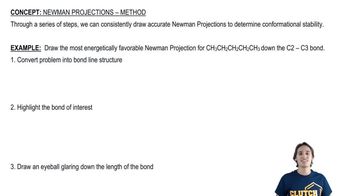
Introduction to Drawing Newman Projections

Conformational Analysis

Conformational analysis involves studying the different spatial arrangements of atoms in a molecule that can be interconverted by rotation around single bonds. Understanding the energy associated with these conformations is crucial, as it helps predict the most stable forms and the energy barriers between them, which is essential for calculating energy differences.
Video consigliato:
03:29
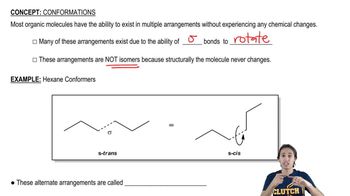
Understanding what a conformer is.

Steric Strain and Torsional Strain

Steric strain arises when atoms are forced closer together than their atomic radii allow, leading to increased energy. Torsional strain occurs due to eclipsing interactions between bonds during rotation around a bond. Both types of strain significantly influence the stability of different conformations, making them key factors in energy calculations.
Video consigliato:
02:00
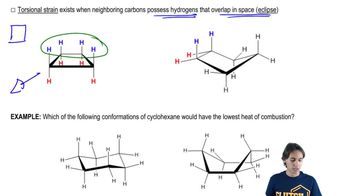
What is torsional strain?
Pratica correlata
Domanda del libro di testo

For each pair of conformations shown, choose which is most stable. If both are equally stable, then write 'no difference.' [If both conformations have the same number of axial substituents, choose the one with the smallest axial substituents.]

(g)

1122
views
Domanda del libro di testo

For each structure shown, draw the two chair conformations and choose which is most stable. Be sure that your second chair is the flipped version of the first. [Make sure that wedged substituents are up in the chair, regardless of whether up is equatorial or axial.]

(g)

1247
views
Domanda del libro di testo

In contrast to ethane and other alkanes studied in this chapter, there is no free rotation around any bonds in cyclopentane (shown below). Why?

1117
views
Domanda del libro di testo

Looking ahead In Chapter 5, we explain that the equilibrium constant (Keq) for a reaction can be calculated based on the difference in energy between reactants and products, according to the following equation:

Keq=e−ΔERTK_{eq}=e^{-\(\frac{\Delta E}{RT}\)}

Using this equation, calculate the equilibrium constant for the 'reaction' shown. [For the rest of the book, if not otherwise specified, assume room temperature (298K).]

1295
views
1
rank
Domanda del libro di testo

For each structure shown, draw the two chair conformations and choose which is most stable. Be sure that your second chair is the flipped version of the first. [Make sure that wedged substituents are up in the chair, regardless of whether up is equatorial or axial.]

(e)

1557
views
Domanda del libro di testo

The normal C(sp3)–C(sp3) bond length is 1.54 Å. The normal bond angle for an sp3-hybridized carbon is 109.5°. The following molecule experiences large deviations from these normal values. Explain these deviations. [Molecular models would be helpful here.]

1001
views