Ch. 4 - Acids and Bases/Electron Flow
Mullins - Organic Chemistry: A Learner Centered Approach 1st Edition
Mullins1st EditionOrganic Chemistry: A Learner Centered ApproachISBN: 9780137566471Non è quello che usi tu?Cambia libro di testo
Capitolo 3, Problema 15c

Based on the one species that is identified for you, label the remaining molecules as acid, base, conjugate acid, or conjugate base.
(c) Chemical reaction diagram showing molecules labeled as acid, base, conjugate acid, and conjugate base.

Guida verificata passo dopo passo
1
Step 1: Identify the species labeled as 'Conjugate Acid' in the image. The molecule with the carbonyl group (C=O) and a hydrogen attached to the alpha carbon is labeled as the conjugate acid.
Step 2: Analyze the reactants. The molecule with the negatively charged nitrogen (NH⁻) is a base because it can accept a proton.
Step 3: Examine the products. The molecule with the negatively charged oxygen (O⁻) is the conjugate base, as it results from the conjugate acid losing a proton.
Step 4: Identify the second product. The molecule with the neutral amine group (H₂N) is the conjugate acid of the base, as it results from the base gaining a proton.
Step 5: Summarize the labels: The reactants are 'Conjugate Acid' and 'Base,' while the products are 'Conjugate Base' and 'Conjugate Acid.' This follows the Bronsted-Lowry acid-base theory.

Risposta video verificata per un problema simile:

Questa soluzione video è stata consigliata dai nostri tutor come utile per risolvere questo problema.
Durata del video:
2m

Concetti chiave

Ecco i concetti essenziali che devi comprendere per rispondere correttamente alla domanda.

Acids and Bases

In organic chemistry, acids are substances that can donate a proton (H+) to another substance, while bases are substances that can accept a proton. This concept is fundamental to understanding acid-base reactions, where the transfer of protons leads to the formation of conjugate acids and bases.
Video consigliato:
02:49
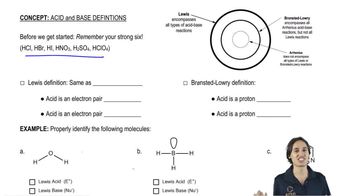
The Lewis definition of acids and bases.

Conjugate Acid and Conjugate Base

A conjugate acid is formed when a base accepts a proton, while a conjugate base is formed when an acid donates a proton. This relationship is crucial in acid-base chemistry, as it helps to identify the species involved in a reaction and predict the direction of equilibrium.
Video consigliato:
03:27
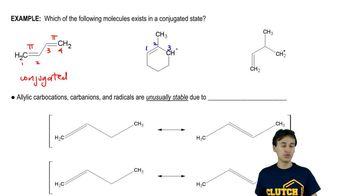
Conjugated states

Equilibrium in Acid-Base Reactions

Acid-base reactions often reach a state of equilibrium, where the rates of the forward and reverse reactions are equal. Understanding this concept allows chemists to predict the favored direction of a reaction based on the strengths of the acids and bases involved, which is essential for labeling the species correctly in the given reaction.
Video consigliato:
04:00
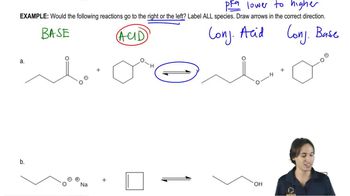
Determining Acid/Base Equilibrium