Ch. 4 - Acids and Bases/Electron Flow
Mullins - Organic Chemistry: A Learner Centered Approach 1st Edition
Mullins1st EditionOrganic Chemistry: A Learner Centered ApproachISBN: 9780137566471Non è quello che usi tu?Cambia libro di testo
Capitolo 3, Problema 17b

Provide an arrow-pushing mechanism for the following hypothetical base half-reactions.
(b)

Guida verificata passo dopo passo
1
Step 1: Identify the nucleophile and electrophile in the reaction. The oxygen atom with lone pairs in the ketone acts as the nucleophile, while the H⁺ (proton) acts as the electrophile.
Step 2: Draw the curved arrow to represent the movement of electrons. The lone pair of electrons on the oxygen atom will attack the H⁺, forming a bond between the oxygen and hydrogen.
Step 3: Update the structure of the ketone after the protonation. The oxygen atom now has a positive charge due to the addition of the proton, as it has gained a bond but lost one lone pair.
Step 4: Ensure the reaction is balanced. Verify that the number of atoms and charges are conserved in the reaction. The protonation of the ketone does not alter the carbon skeleton.
Step 5: Review the mechanism for clarity. Confirm that the arrow-pushing correctly represents the electron flow from the nucleophile (oxygen) to the electrophile (H⁺), resulting in the protonated ketone.

Risposta video verificata per un problema simile:

Questa soluzione video è stata consigliata dai nostri tutor come utile per risolvere questo problema.

Concetti chiave

Ecco i concetti essenziali che devi comprendere per rispondere correttamente alla domanda.

Arrow-Pushing Mechanism

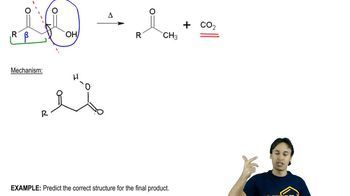
Arrow-pushing is a notation used in organic chemistry to illustrate the movement of electrons during chemical reactions. It involves using arrows to show the direction of electron flow, indicating how bonds are formed or broken. This mechanism is crucial for visualizing reaction pathways, especially in acid-base reactions where proton transfer occurs.
Video consigliato:
04:32
General Mechanism

Acid-Base Reactions

Acid-base reactions involve the transfer of protons (H+) between reactants. An acid donates a proton, while a base accepts it. Understanding the strength of acids and bases, as well as their conjugate pairs, is essential for predicting the outcome of these reactions and for applying the arrow-pushing mechanism correctly.
Video consigliato:
02:49
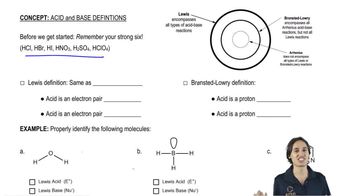
The Lewis definition of acids and bases.

Conjugate Acid-Base Pairs

Conjugate acid-base pairs consist of two species that differ by the presence or absence of a proton. When an acid donates a proton, it becomes its conjugate base, and when a base accepts a proton, it becomes its conjugate acid. Recognizing these pairs is vital for understanding the equilibrium of acid-base reactions and the stability of the resulting species.
Video consigliato:
Percorso guidato
2:56
Base Pairing Concept 1