Ch. 4 - Acids and Bases/Electron Flow
Mullins - Organic Chemistry: A Learner Centered Approach 1st Edition
Mullins1st EditionOrganic Chemistry: A Learner Centered ApproachISBN: 9780137566471Non è quello che usi tu?Cambia libro di testo
Capitolo 3, Problema 38d

Calculate Keq for these acid–base reactions.
(d)

Guida verificata passo dopo passo
1
Step 1: Identify the acid and base on both sides of the reaction. In this case, the alcohol (CH3CH2OH) acts as the acid, and hydroxide ion (OH⁻) acts as the base. On the product side, the ethoxide ion (CH3CH2O⁻) is the conjugate base, and water (H2O) is the conjugate acid.
Step 2: Determine the pKa values of the acid and conjugate acid. The pKa of ethanol (CH3CH2OH) is approximately 16, and the pKa of water (H2O) is approximately 15.7.
Step 3: Use the relationship between pKa values and equilibrium constant (Keq). The formula is: Keq = 10^(pKa(conjugate acid) - pKa(acid)).
Step 4: Substitute the pKa values into the formula. Here, pKa(conjugate acid) = 15.7 (for H2O) and pKa(acid) = 16 (for CH3CH2OH).
Step 5: Calculate the exponent (pKa difference) and express the equilibrium constant (Keq) in terms of 10 raised to the power of the difference. This will give the final Keq value for the reaction.

Risposta video verificata per un problema simile:

Questa soluzione video è stata consigliata dai nostri tutor come utile per risolvere questo problema.

Concetti chiave

Ecco i concetti essenziali che devi comprendere per rispondere correttamente alla domanda.

Equilibrium Constant (K_eq)

The equilibrium constant, K_eq, quantifies the ratio of the concentrations of products to reactants at equilibrium for a given reaction. It is calculated using the formula K_eq = [products]/[reactants], where the concentrations are raised to the power of their coefficients in the balanced equation. A K_eq greater than 1 indicates that products are favored, while a value less than 1 suggests that reactants are favored.
Video consigliato:
02:19
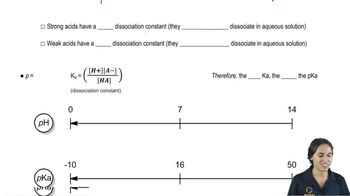
The relationship between equilibrium constant and pKa.

Acid-Base Reactions

Acid-base reactions involve the transfer of protons (H+) between reactants. In these reactions, acids donate protons, while bases accept them. Understanding the strength of acids and bases, often represented by their dissociation constants (K_a for acids and K_b for bases), is crucial for predicting the direction of the reaction and calculating K_eq.
Video consigliato:
02:49
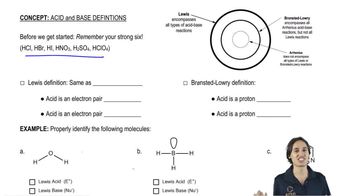
The Lewis definition of acids and bases.

Le Chatelier's Principle

Le Chatelier's Principle states that if a system at equilibrium is disturbed, the system will adjust to counteract the disturbance and restore a new equilibrium. This principle is essential in predicting how changes in concentration, pressure, or temperature will affect the position of equilibrium in acid-base reactions, thereby influencing the calculation of K_eq.
Video consigliato:
04:12
The Electron Configuration