Ch. 4 - Acids and Bases/Electron Flow
Mullins - Organic Chemistry: A Learner Centered Approach 1st Edition
Mullins1st EditionOrganic Chemistry: A Learner Centered ApproachISBN: 9780137566471Non è quello che usi tu?Cambia libro di testo
Capitolo 3, Problema 39d

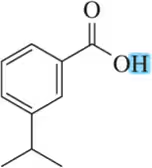
For each indicated proton, suggest an approximate pKa value from Table 4.5. Rationalize your choice.
(d) Chemical structure of a phenolic compound with a hydroxyl group highlighted, indicating its acidic proton for pKa analysis.

Guida verificata passo dopo passo
1
Identify the functional group or type of proton in the molecule. For example, determine if the proton is part of an alcohol (-OH), carboxylic acid (-COOH), amine (-NH₂), or other functional group.
Refer to Table 4.5 (or a similar pKₐ reference table) to find the typical pKₐ range for the functional group or type of proton identified in the previous step.
Consider the molecular environment around the proton. For example, assess whether there are electron-withdrawing or electron-donating groups nearby, as these can influence the acidity and shift the pKₐ value.
Rationalize your choice by explaining how the molecular structure and substituents affect the proton's acidity. For instance, electron-withdrawing groups stabilize the conjugate base, lowering the pKₐ, while electron-donating groups have the opposite effect.
Assign an approximate pKₐ value based on the functional group and the specific molecular context, ensuring it aligns with the trends observed in the reference table.

Risposta video verificata per un problema simile:

Questa soluzione video è stata consigliata dai nostri tutor come utile per risolvere questo problema.
Durata del video:
2m

Concetti chiave

Ecco i concetti essenziali che devi comprendere per rispondere correttamente alla domanda.

pKₐ and Acid-Base Strength

pKₐ is a quantitative measure of the strength of an acid in solution. It is the negative logarithm of the acid dissociation constant (Kₐ), with lower pKₐ values indicating stronger acids. Understanding pKₐ is essential for predicting the behavior of protons in various chemical environments, as it helps determine the likelihood of proton donation.
Video consigliato:
Percorso guidato
2:50
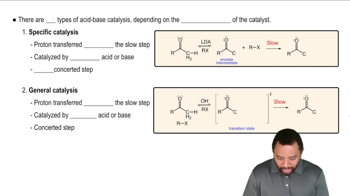
Acid-Base Catalysis Concept 3

Protonation and Deprotonation

Protonation refers to the addition of a proton (H⁺) to a molecule, while deprotonation is the removal of a proton. The pKₐ value of a proton indicates the equilibrium position of these processes. Knowing which protons are likely to be protonated or deprotonated under specific conditions is crucial for rationalizing pKₐ values.
Video consigliato:
03:
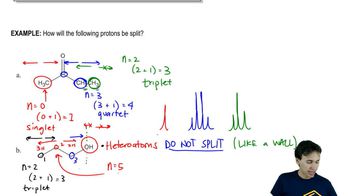
Proton Splitting

Contextual Factors Influencing pKₐ

The pKₐ of a proton can be influenced by various factors, including the molecular structure, electronegativity of nearby atoms, and solvent effects. For example, electron-withdrawing groups can stabilize the negative charge of the conjugate base, leading to a lower pKₐ. Understanding these contextual factors is vital for accurately estimating pKₐ values from tables.
Video consigliato:
00:57
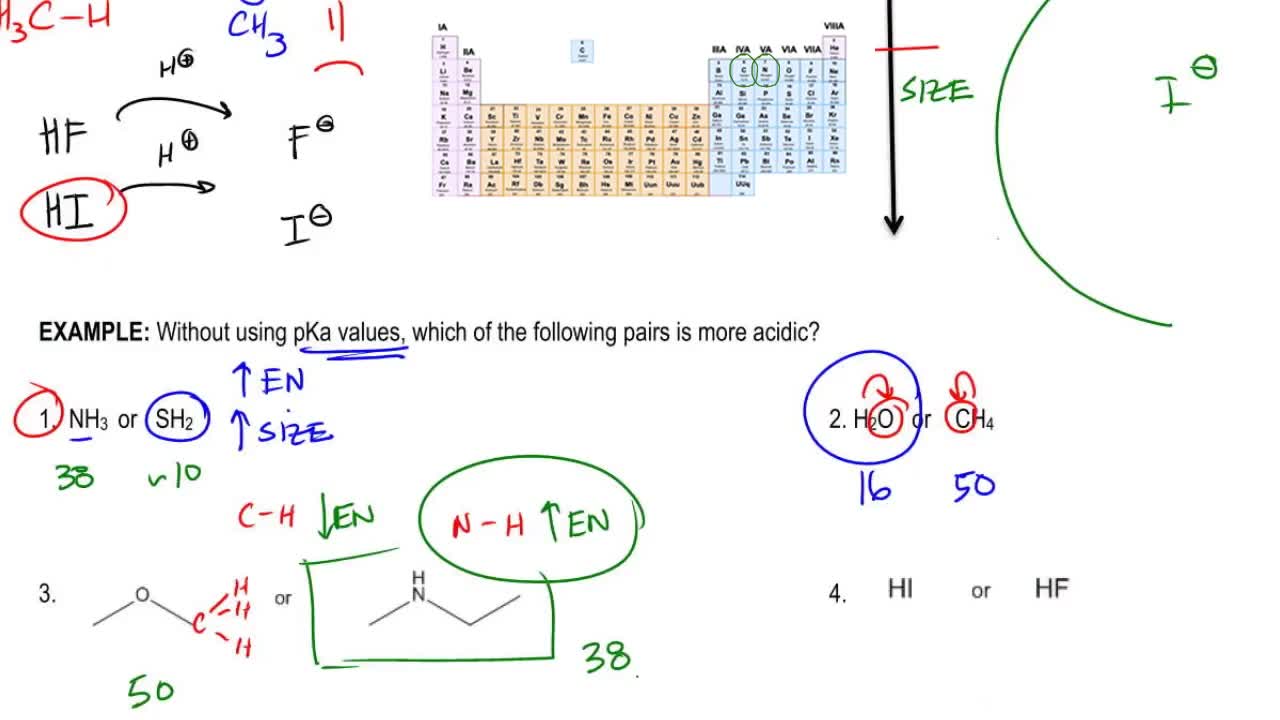
Using factors affecting acidity to rank acids