Ch. 4 - Acids and Bases/Electron Flow
Mullins - Organic Chemistry: A Learner Centered Approach 1st Edition
Mullins1st EditionOrganic Chemistry: A Learner Centered ApproachISBN: 9780137566471Non è quello che usi tu?Cambia libro di testo
Capitolo 3, Problema 59c

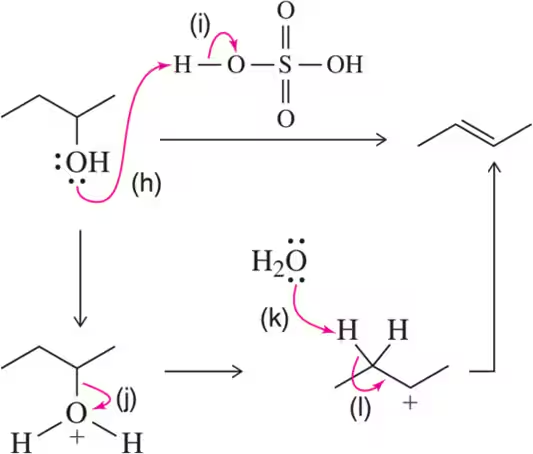
Identify the arrow types that are shown in each of these arrow-pushing mechanisms.
(iii) Diagram illustrating arrow-pushing mechanisms in a chemical reaction, highlighting various arrow types and electron movement.

Guida verificata passo dopo passo
1
Examine the arrow types in the given mechanism. In organic chemistry, curved arrows are used to depict the movement of electrons. There are two main types of curved arrows: (1) full-headed arrows, which represent the movement of an electron pair, and (2) half-headed arrows (fishhook arrows), which represent the movement of a single electron.
Identify the starting point of each arrow. A curved arrow typically starts at the source of electrons, such as a lone pair, a bond, or a negative charge.
Determine the destination of each arrow. The arrowhead points to where the electrons are moving, such as forming a new bond, breaking an existing bond, or creating a lone pair on an atom.
Classify the type of electron movement depicted by each arrow. For example, if the arrow starts at a bond and points to an atom, it represents bond cleavage. If it starts at a lone pair and points to a bond, it represents bond formation.
Review the context of the mechanism to ensure the arrow types are consistent with the reaction steps. For example, nucleophilic attack, bond breaking, or resonance structures should align with the arrow-pushing conventions.

Risposta video verificata per un problema simile:

Questa soluzione video è stata consigliata dai nostri tutor come utile per risolvere questo problema.
Durata del video:
6m

Concetti chiave

Ecco i concetti essenziali che devi comprendere per rispondere correttamente alla domanda.

Arrow-Pushing Mechanism

Arrow-pushing mechanisms are a way to represent the movement of electrons during chemical reactions. They use arrows to indicate the direction of electron flow, helping to visualize how bonds are formed or broken. Understanding these mechanisms is crucial for predicting the outcome of reactions and for grasping the underlying principles of organic chemistry.
Video consigliato:
04:32
General Mechanism

Types of Arrows

In organic chemistry, different types of arrows are used to convey specific actions. A single-headed arrow indicates the movement of one electron (radical reactions), while a double-headed arrow shows the movement of a pair of electrons (nucleophilic attacks or bond formation). Understanding these distinctions is essential for accurately interpreting reaction mechanisms.
Video consigliato:
10:22
Common ways to move arrows in resonance.

Reaction Mechanisms

Reaction mechanisms describe the step-by-step process by which reactants transform into products. They provide insight into the sequence of bond-breaking and bond-forming events, which is essential for understanding how and why reactions occur. Familiarity with various mechanisms allows chemists to predict reaction outcomes and design new synthetic pathways.
Video consigliato:
02:16
Heck Reaction Mechanism