Ch. 4 - Acids and Bases/Electron Flow
Mullins - Organic Chemistry: A Learner Centered Approach 1st Edition
Mullins1st EditionOrganic Chemistry: A Learner Centered ApproachISBN: 9780137566471Non è quello che usi tu?Cambia libro di testo
Capitolo 3, Problema 59d

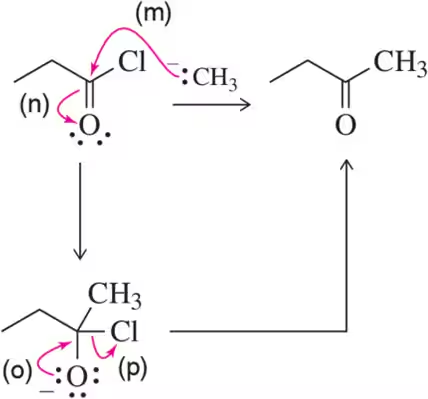
Identify the arrow types that are shown in each of these arrow-pushing mechanisms.
(iv) Diagram illustrating arrow-pushing mechanisms in a chemical reaction, highlighting specific arrow types and reactants.

Guida verificata passo dopo passo
1
Step 1: Analyze the first arrow labeled (a). This arrow represents the movement of electrons from the lone pair on the oxygen atom to form a double bond with the carbon atom. This is an example of a 'lone pair to bond' arrow.
Step 2: Examine the second arrow labeled (b). This arrow shows the movement of electrons from the carbon-chlorine bond to the chlorine atom, breaking the bond. This is an example of a 'bond to lone pair' arrow.
Step 3: Look at the third arrow labeled (c). This arrow represents the movement of electrons from the lone pair on the hydroxide ion (HO⁻) to the carbon atom, forming a bond. This is an example of a 'lone pair to bond' arrow.
Step 4: Observe the fourth arrow labeled (d). This arrow shows the movement of electrons from the carbon-chlorine bond to the chlorine atom, breaking the bond. This is another example of a 'bond to lone pair' arrow.
Step 5: Summarize the mechanism. The arrow-pushing mechanism involves electron movement to form and break bonds, specifically 'lone pair to bond' and 'bond to lone pair' types of arrows, facilitating the substitution reaction.

Risposta video verificata per un problema simile:

Questa soluzione video è stata consigliata dai nostri tutor come utile per risolvere questo problema.
Durata del video:
7m

Concetti chiave

Ecco i concetti essenziali che devi comprendere per rispondere correttamente alla domanda.

Arrow-Pushing Mechanism

Arrow-pushing mechanisms are a way to represent the movement of electrons during chemical reactions. In these diagrams, arrows indicate the direction of electron flow, showing how bonds are formed or broken. Understanding these mechanisms is crucial for predicting the outcome of reactions and for grasping the underlying principles of organic chemistry.
Video consigliato:
04:32
General Mechanism

Nucleophiles and Electrophiles

Nucleophiles are species that donate an electron pair to form a chemical bond, while electrophiles are electron-deficient species that accept electron pairs. In arrow-pushing mechanisms, nucleophiles typically attack electrophiles, leading to bond formation. Recognizing these roles is essential for analyzing reaction pathways and understanding how different reagents interact.
Video consigliato:
03:
Nucleophile or Electrophile

Resonance Structures

Resonance structures are different ways of drawing the same molecule that illustrate the delocalization of electrons. They help in understanding the stability and reactivity of intermediates in a reaction. In arrow-pushing mechanisms, resonance can explain the movement of electrons and the formation of stable products, making it a key concept in organic reaction mechanisms.
Video consigliato:
03:04
Drawing Resonance Structures