Ch. 4 - Acids and Bases/Electron Flow
Mullins - Organic Chemistry: A Learner Centered Approach 1st Edition
Mullins1st EditionOrganic Chemistry: A Learner Centered ApproachISBN: 9780137566471Non è quello che usi tu?Cambia libro di testo
Capitolo 3, Problema 55a

Identify the nucleophile and the electrophile in each of the following reactions.
(a)

Guida verificata passo dopo passo
1
Step 1: Analyze the reaction provided in the image. The reaction involves methanol (CH₃OH) and a tertiary alcohol with a positively charged oxygen atom (OH⁺). The arrow indicates the movement of electrons from the lone pair on the oxygen atom of methanol to the positively charged oxygen atom of the tertiary alcohol.
Step 2: Define the nucleophile. A nucleophile is a species that donates a pair of electrons to form a bond. In this reaction, methanol (CH₃OH) acts as the nucleophile because its oxygen atom has lone pairs of electrons that can be donated.
Step 3: Define the electrophile. An electrophile is a species that accepts a pair of electrons to form a bond. In this reaction, the positively charged oxygen atom (OH⁺) of the tertiary alcohol acts as the electrophile because it is electron-deficient and can accept electrons.
Step 4: Explain the interaction. The lone pair of electrons on the oxygen atom of methanol is attracted to the positively charged oxygen atom of the tertiary alcohol. This results in the formation of a new bond between the oxygen atoms.
Step 5: Summarize the roles. Methanol (CH₃OH) is the nucleophile, donating electrons, and the positively charged oxygen atom (OH⁺) of the tertiary alcohol is the electrophile, accepting electrons.

Risposta video verificata per un problema simile:

Questa soluzione video è stata consigliata dai nostri tutor come utile per risolvere questo problema.

Concetti chiave

Ecco i concetti essenziali che devi comprendere per rispondere correttamente alla domanda.

Nucleophile

A nucleophile is a species that donates an electron pair to form a chemical bond in a reaction. Nucleophiles are typically negatively charged or neutral molecules with lone pairs of electrons. In the provided reaction, the hydroxide ion (OH-) acts as a nucleophile, attacking the electrophile to form a new bond.
Video consigliato:
08:27
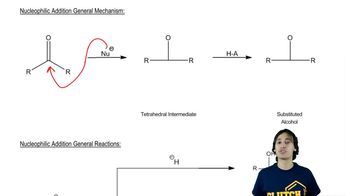
Nucleophilic Addition

Electrophile

An electrophile is a chemical species that accepts an electron pair from a nucleophile during a reaction. Electrophiles are usually positively charged or electron-deficient species. In the given reaction, the carbon atom in the alcohol group (attached to the hydroxyl group) acts as the electrophile, as it is susceptible to attack by the nucleophile.
Video consigliato:
03:
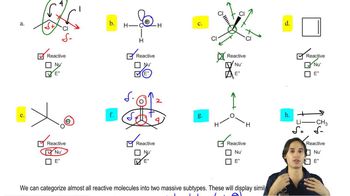
Nucleophile or Electrophile

Reaction Mechanism

A reaction mechanism describes the step-by-step sequence of elementary reactions by which overall chemical change occurs. Understanding the mechanism helps in identifying the roles of nucleophiles and electrophiles in a reaction. In this case, the mechanism illustrates how the nucleophile attacks the electrophile, leading to the formation of a new product.
Video consigliato:
02:16
Heck Reaction Mechanism